Retiring boomers broke this important economic relationship
Retiring boomers broke this important economic relationship

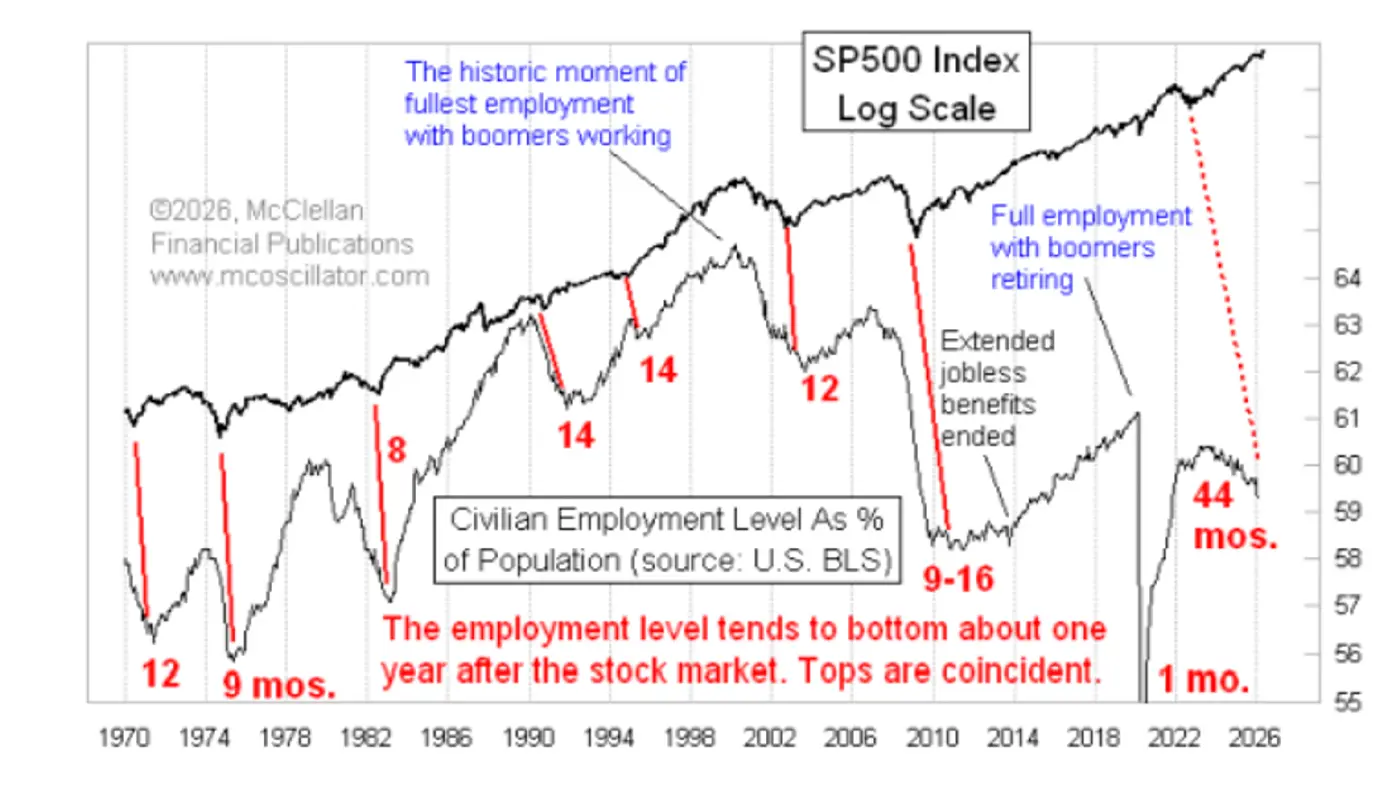
The employment level as a percentage of the U.S. population continues to fall, even though the stock market has been rising. That breaks a long-standing relationship, as shown in the following chart.
Source: McClellan Financial Publications
Normally, the employment level as a percentage of the population bottoms about a year after an important stock market bottom. The last such price bottom was in September 2022, on a monthly basis. That should have meant a bottom for the employment-population ratio around September 2023. Instead, the ratio has continued to fall.
The unemployment rate has held up well during that period, ranging from the high 3% range to the low 4% range now. So this is not as much a problem of people being unable to find work. Rather, you can blame the retiring baby boom generation.
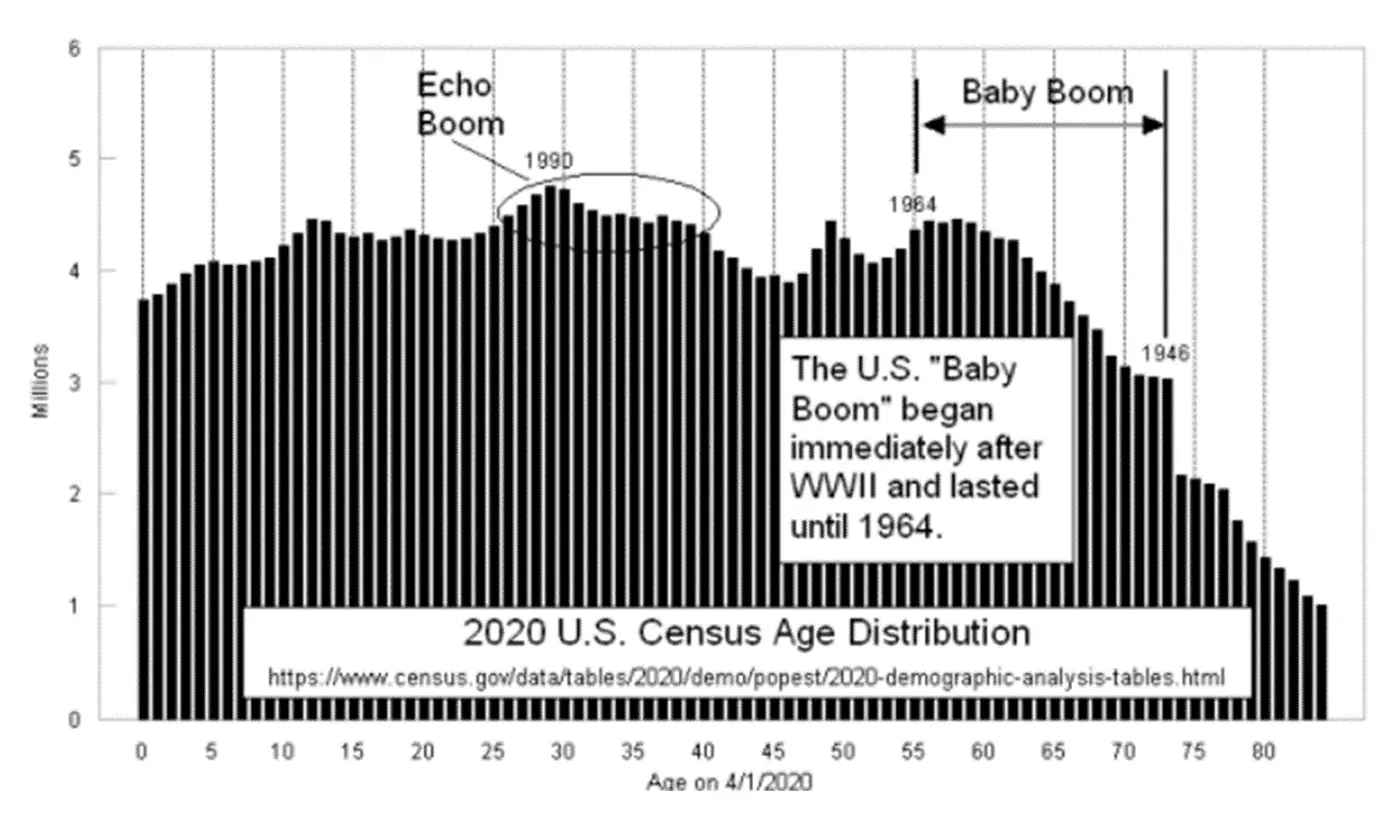
When World War II ended in August 1945, GIs came home, Rosie the Riveter gave up her factory job, and Americans got busy making babies. That led to a large spike in births in 1946.
That continued until 1964, which coincidentally was one year after Ortho Pharmaceuticals introduced the first oral birth control pill. As of the 2020 census, that 1946–1964 birth-year cohort totaled 73.5 million, or 22% of the total U.S. population.
 Related Article: How the sequence of investment returns impacts investors
Source: McClellan Financial Publications
Those baby boomers are now 62 to 80 years old, so it is understandable that they would be leaving the workforce. This effect is magnified because the 1946–1964 baby boom generation has long been skewed to the more recent birth years, with 1960 being the peak birth year for the boomers. That 1960 cohort reaches full Social Security retirement age at 66 years and 10 months, so more of them will soon be checking out of the workforce. Those who were born before 1960 have already been doing that, which is why we see the employment-population ratio falling in the first chart.
Much has already been written about how supporting these pensioners as they leave the workforce will create great strain on the economy and the federal budget. I won’t belabor that here, but I will point out that we will get to repeat all of this about 30 years later, when the echo boom generation—the children of baby boomers—reaches retirement age. Births for that generation peaked in 1990.
Why this matters for stock market investors is that the retiring baby boomers will start drawing down their investment holdings at a greater rate to support their preferred lifestyles in retirement. That has not been much of a problem so far, with the Federal Reserve now doing QE5 and helping keep the stock market up. Rising stock prices have helped soften the effects of any stock selling that baby boomers may have been doing. A meaningful stock market downturn during this demographic shift would mean drawing down retirement accounts’ stock holdings even more.
That is not an insight one can trade on. It is just important background information about what challenges lie ahead.
This is an edited version of an article that first appeared at McClellan Financial Publications on May 22, 2026.
The opinions expressed in this article are those of the author and the sources cited and do not necessarily represent the views of Proactive Advisor Magazine. This material is presented for educational purposes only.
 Tom McClellan is the editor of The McClellan Market Report newsletter and its companion, Daily Edition. He started that publication in 1995 with his father Sherman McClellan, the co-creator of the McClellan Oscillator, and Tom still has the privilege of working with his father. Tom is a 1982 graduate of West Point, and served 11 years as an Army helicopter pilot before moving to his current career. Tom was named by Timer Digest as the #1 Long-Term Stock Market Timer for both 2011 and 2012. mcoscillator.com
RECENT POSTS

Passing the baton to the next generation of financial advisors

The age of immediacy—and why investing still requires patience

Committed to clients’ financial clarity and confidence

Existing home sales slide in August, but affordability may improve