QE may be bearish for T-bonds
QE may be bearish for T-bonds

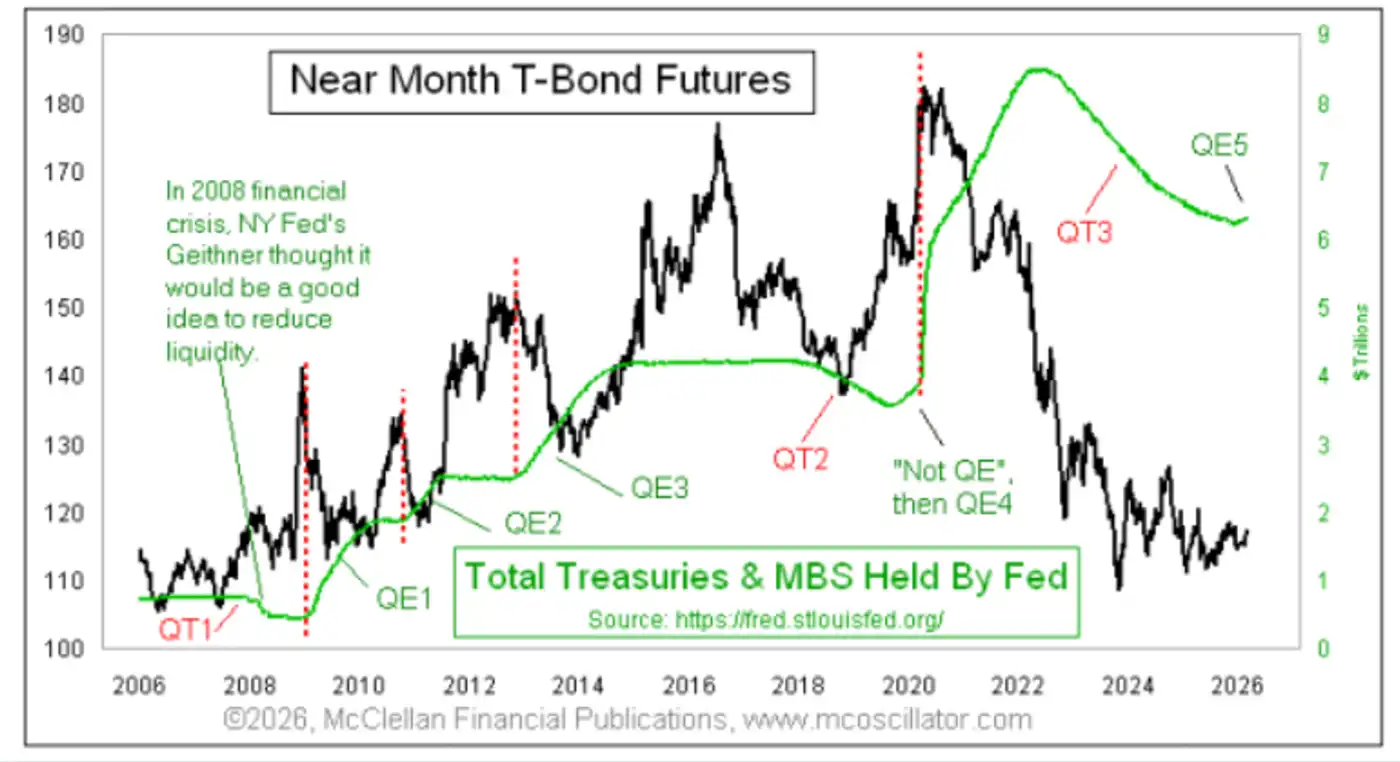
The Federal Reserve is now doing QE5, although we are not supposed to officially call it that yet. All four previous rounds of quantitative easing (QE) have been unquestionably bullish for the stock market. But the same cannot be said for T-bond prices.
Source: McClellan Financial Publications
 Related Article: ‘Hindenburg Omen’ signals are back
During all four previous QE episodes, T-bond prices have seen a dramatic drop, which also means a rise in long-term yields. So if QE5 unfolds in the same way, then we can look forward to higher long-term yields on T-bonds, and presumably also on home mortgages and other long-term debt.
One factor that is different this time is that bond prices have not just seen a big rally leading up to the start of QE5. All four previous episodes saw QE starting when bond prices were at a spike top. So there was a lot of room each prior time for bond prices to give back the big gains they had just made. This time, there has been only a small rise in T-bond prices.
Why would QE be bad for bonds? This does not make intuitive sense. After all, if the Fed is going to step in as a new incremental buyer of Treasury debt, then that additional demand should mean upward pressure on prices. Yet, we see it works the opposite way.
Part of the answer is that the Fed’s purchases of Treasury debt during prior rounds of QE have tended to be in shorter-maturity instruments—T-bills and T-notes. So they are not adding very much direct additional buying pressure at the long end of the yield curve.
QE also acts as an economic stimulus, which in theory drives up demand for longer-term credit from businesses looking to finance expansion. That puts upward pressure on longer-term rates.
That is all great in theory, but what remains unknown is whether it can work the same way a fifth time without a big run-up in bond prices first.
This is an edited version of an article that first appeared at McClellan Financial Publications on Feb. 20, 2026. The article was written before the current escalation of the Iran conflict.
The opinions expressed in this article are those of the author and the sources cited and do not necessarily represent the views of Proactive Advisor Magazine. This material is presented for educational purposes only.
 Tom McClellan is the editor of The McClellan Market Report newsletter and its companion, Daily Edition. He started that publication in 1995 with his father Sherman McClellan, the co-creator of the McClellan Oscillator, and Tom still has the privilege of working with his father. Tom is a 1982 graduate of West Point, and served 11 years as an Army helicopter pilot before moving to his current career. Tom was named by Timer Digest as the #1 Long-Term Stock Market Timer for both 2011 and 2012. mcoscillator.com
RECENT POSTS

Passing the baton to the next generation of financial advisors

The age of immediacy—and why investing still requires patience

Committed to clients’ financial clarity and confidence

Existing home sales slide in August, but affordability may improve