Do oil price spikes derail stocks?
Do oil price spikes derail stocks?
The price of oil is one of the most important drivers of current stock market returns.
Because the recent price spike is a direct result of the war with Iran, it may conjure memories of the 1970s Middle East conflicts and their terrible impact on the economy and, in turn, the stock market. That was a painful episode of oil market turmoil. But does the current situation doom stock market performance?
Using West Texas Intermediate (WTI) crude oil prices, we define an oil price spike as a month in which the price rises more than 40% above its trailing 12-month average. There were 18 such spikes over the past 40 years. March 2026 qualifies, with a 51% price spike based on this criterion.
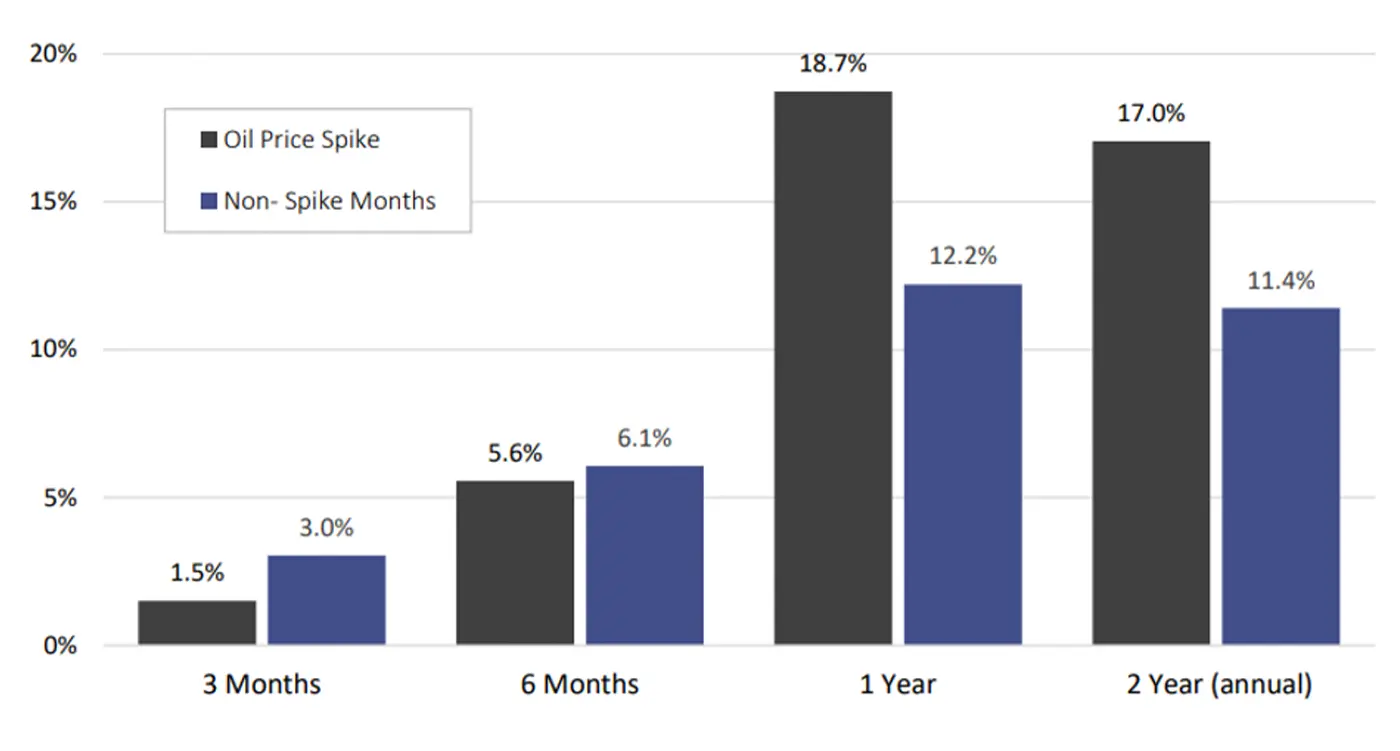
The following chart shows that stock market returns were weak in the six months after an oil spike. But for two years after the spike, the market generated exceptional returns of 17% to 19%, beating the non-spike years by 6 percentage points.
While it might be tempting to try to time the market’s reaction to a spike, the best strategy seems to be staying invested in the face of suddenly higher oil prices.
S&P 500 RETURNS AFTER OIL PRICE SPIKES (1986–2026)
Sources: AthenaInvest, St. Louis Federal Reserve FRED, Morningstar
 Related Article: Active ‘stock picking’ or passive market exposure?
From the behavioral viewpoint
What is going on?
- Availability cascade: We give more weight to information that is readily available or recent, even if it is not the most relevant or accurate. This is particularly the case today as we drive our vehicles around, faced with the high price of gasoline.
- WYSIATI—“What you see is all there is”: Daniel Kahneman introduced this cognitive bias to describe the human tendency to make decisions or judgments based solely on the information readily available to them, without accounting for what they do not know or have not considered.
- Myopic loss aversion: We feel worse about a loss than we feel good about an equivalent gain, about twice as bad. Even though we have a long-term planning horizon, the chance of a short-term loss triggers the ancient and strong fight-or-flight emotions.
What can investors do?
- Individual events are rarely a reliable basis for making investment decisions. Tune out the media when it comes to investments. Use a consistent approach to monitor the markets and the economy to keep emotions in check.
- Use needs-based planning to separate short- and long-term investments and insulate them from short-term noise. Follow a well-developed investment process that delivers critical discipline.
- Work with an experienced behavioral financial advisor. They can provide valuable perspective and coaching to help stay on track and remain focused on long-term plans.
This is an edited version of an article that was first published by AthenaInvest on Apr. 9, 2026.
The opinions expressed in this article are those of the author and the sources cited and do not necessarily represent the views of Proactive Advisor Magazine. This material is presented for educational purposes only.
 C. Thomas Howard, Ph.D., is the director of research and portfolio manager at Quartz Partners Investment Management. Dr. Howard is a professor emeritus in the Reiman School of Finance, Daniels College of Business at the University of Denver. Dr. Howard is the author of the book “Behavioral Portfolio Management” and co-author of “Return of the Active Manager.” Dr. Howard applies behavioral finance principles to investment management and provides educational resources for the financial community.
RECENT POSTS

Passing the baton to the next generation of financial advisors

The age of immediacy—and why investing still requires patience

Committed to clients’ financial clarity and confidence

Existing home sales slide in August, but affordability may improve