‘Hindenburg Omen’ signals are back
‘Hindenburg Omen’ signals are back

The NYSE’s daily advance-decline (A/D) line made a new all-time high on Feb. 4, 2026—a sign that liquidity is plentiful. But just a day later, we saw the third Hindenburg Omen within six trading days. This suggests that despite supposedly plentiful liquidity, the market has some serious problems.
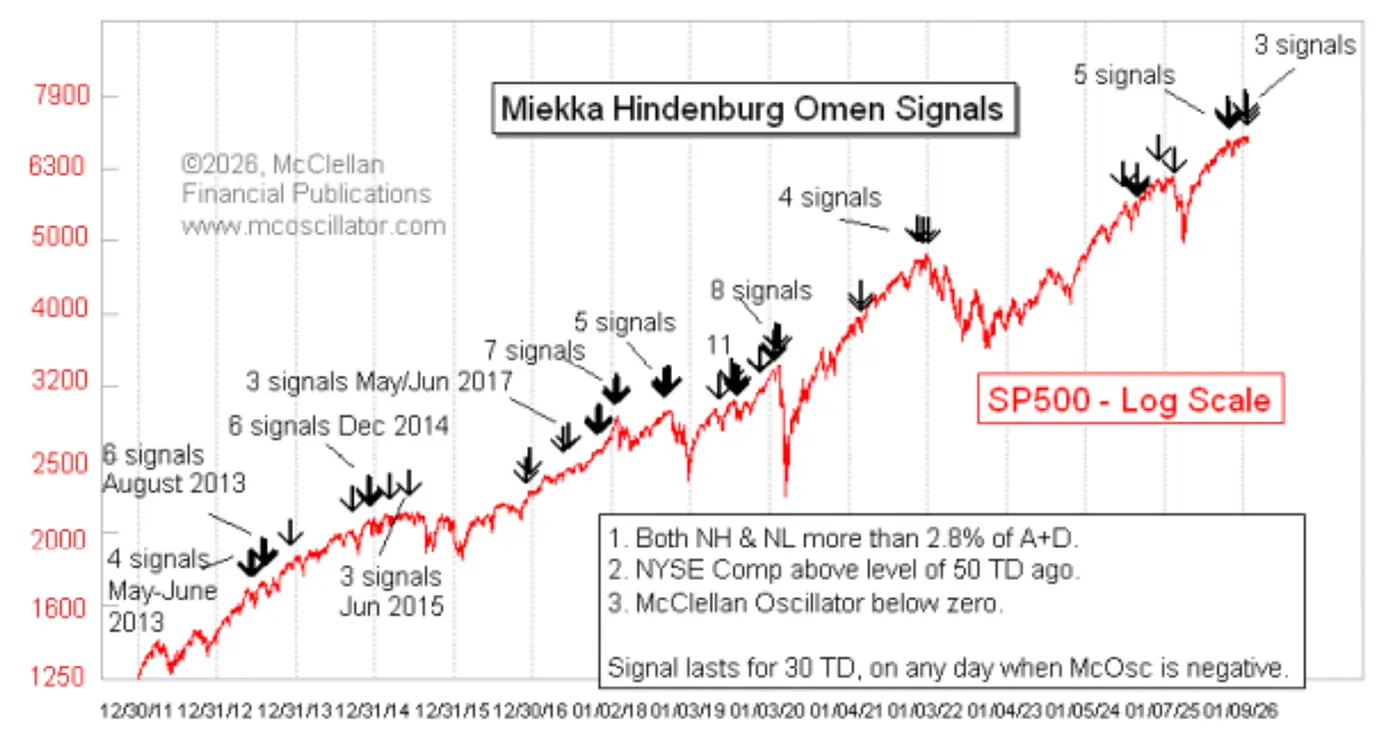
The late Jim Miekka created the Hindenburg Omen signal back in 1995. He intended it as an improvement on the late Gerald Appel’s “Split Market Sell Signal,” which was triggered on any day when both new highs and new lows on the NYSE exceeded 45 issues. Miekka recognized that this approach does not adjust for the increased number of issues traded. He also wanted to add other filtering rules to get better signals. An important one is that the market has to be in an uptrend to give a signal. Miekka thought it was not very useful to get such a warning once stock prices were already in a downtrend. The criteria for a Hindenburg Omen signal are listed in the following chart.
FIGURE 1: HINDENBURG OMEN SIGNALS SINCE 2011
Source: McClellan Financial Publications
 Related Article: Find out if bulls or bears are in control with this ‘magic trick’
If you do an internet search, you will likely find other sets of criteria on some technical analysis websites, which is unfortunate. Because Miekka has passed away, we cannot ask him to correct the record, so that task is left to others. The criteria I use are those Miekka personally shared with Greg Morris, who recorded them in his 2005 book, “The Complete Guide to Market Breadth Indicators.”
The basic idea behind the Hindenburg Omen signal is that during a normal uptrend, more stocks should be making new highs than new lows. That is the normal condition. If the uptrend is still underway but the number of new lows starts perking up, then that is a sign of trouble. What constitutes “perking up”? That’s a matter of opinion, and perhaps backtesting. Miekka set his threshold at both new highs and new lows exceeding 2.8% of advances plus declines on the same day. Other analysts may choose different criteria, which they are free to do. But for the sake of consistency, and to avoid confusion, I stick with Miekka’s criteria.
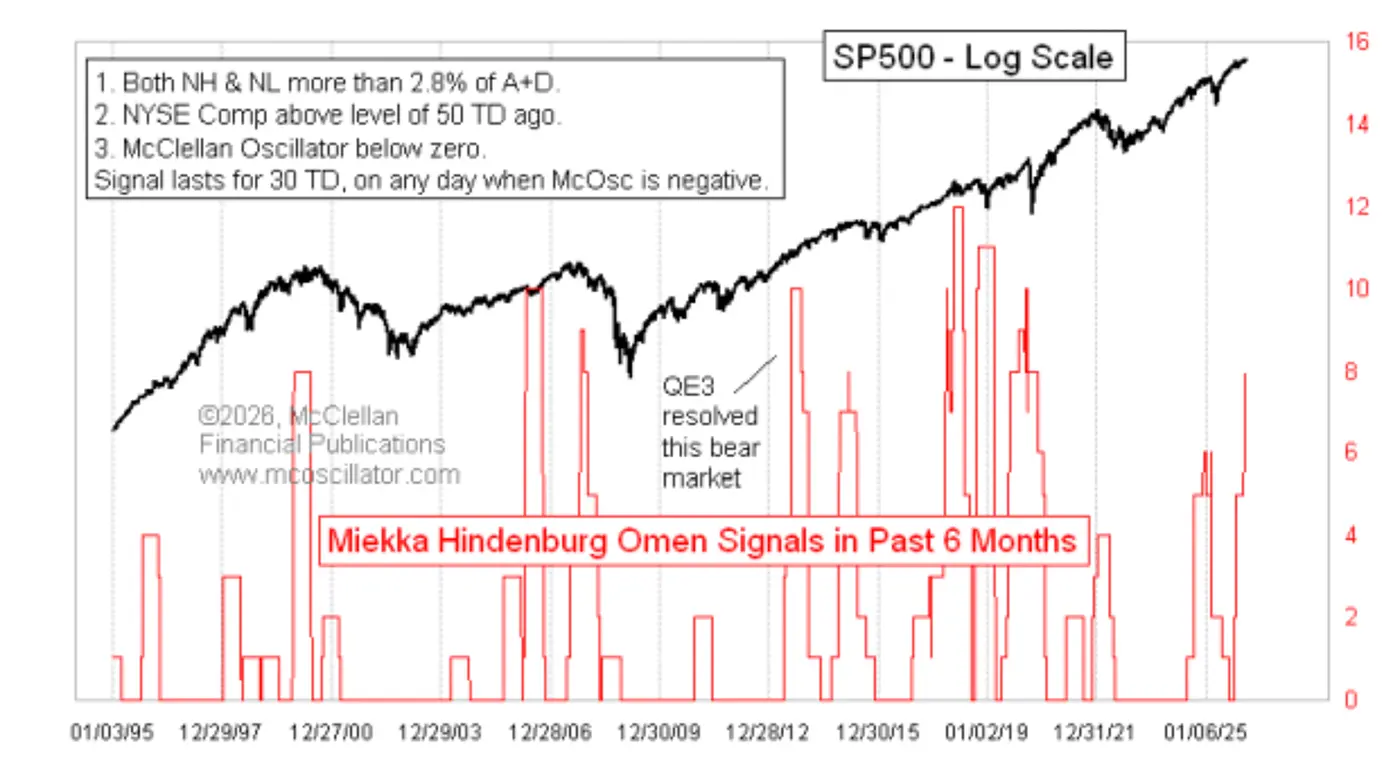
A single signal is interesting, but the message gets more compelling when we see clusters of signals in a short time frame. We saw a grouping of five signals from Oct. 29 to Nov. 13, 2025, but the market shrugged them off. Now we have three more (so far) and would have had a fourth on Feb. 4, 2026, except that the NYSE’s McClellan A-D Oscillator was just barely positive that day.
FIGURE 2: CLUSTERS OF HINDENBURG OMEN SIGNALS
Source: McClellan Financial Publications
I have found that using a six-month look-back period to count cumulative Hindenburg Omen signals is useful. On that basis, we are now up to eight signals, which is a pretty high reading. Some noteworthy market tops have followed readings like this. That said, there have also been times when we saw a cluster of Hindenburg Omen signals and nothing much happened. That is possible. A Hindenburg Omen signal, or a bunch of them, is a warning but not a guarantee of trouble. It says “pay extra attention.”
The last such cluster appeared at the end of 2024, right after the presidential election. It did not tell us exactly what trouble was brewing, but it did appear just ahead of the stock market’s violent drop on tariff worries, courtesy of President Trump. A smaller cluster appeared in early 2022, ahead of that year’s bear market.
It is also worth noting that there was a cluster of 10 signals in 2013, and the uptrend just powered on through. At the time, the Federal Reserve was implementing QE3, and quantitative easing can paper over lots of problems. The Fed is now engaged in another round, QE5, although not as vigorously as some past QE episodes. So it is possible that the Fed will paper over the trouble again this time.
This is an edited version of an article that first appeared at McClellan Financial Publications on Feb. 5, 2026.
The opinions expressed in this article are those of the author and the sources cited and do not necessarily represent the views of Proactive Advisor Magazine. This material is presented for educational purposes only.
 Tom McClellan is the editor of The McClellan Market Report newsletter and its companion, Daily Edition. He started that publication in 1995 with his father Sherman McClellan, the co-creator of the McClellan Oscillator, and Tom still has the privilege of working with his father. Tom is a 1982 graduate of West Point, and served 11 years as an Army helicopter pilot before moving to his current career. Tom was named by Timer Digest as the #1 Long-Term Stock Market Timer for both 2011 and 2012. mcoscillator.com
RECENT POSTS

Passing the baton to the next generation of financial advisors

The age of immediacy—and why investing still requires patience

Committed to clients’ financial clarity and confidence

Existing home sales slide in August, but affordability may improve