Looming economic slowdown is the Fed’s fault
Looming economic slowdown is the Fed’s fault

The Challenger, Gray & Christmas report on corporate layoffs just posted at 153,000, the worst October since 2003. Economists are floating numerous explanations for this, including the government shutdown, tariffs, and other “usual suspects.” But I put the blame right at the feet of the Federal Reserve for keeping interest rates too high since 2023.
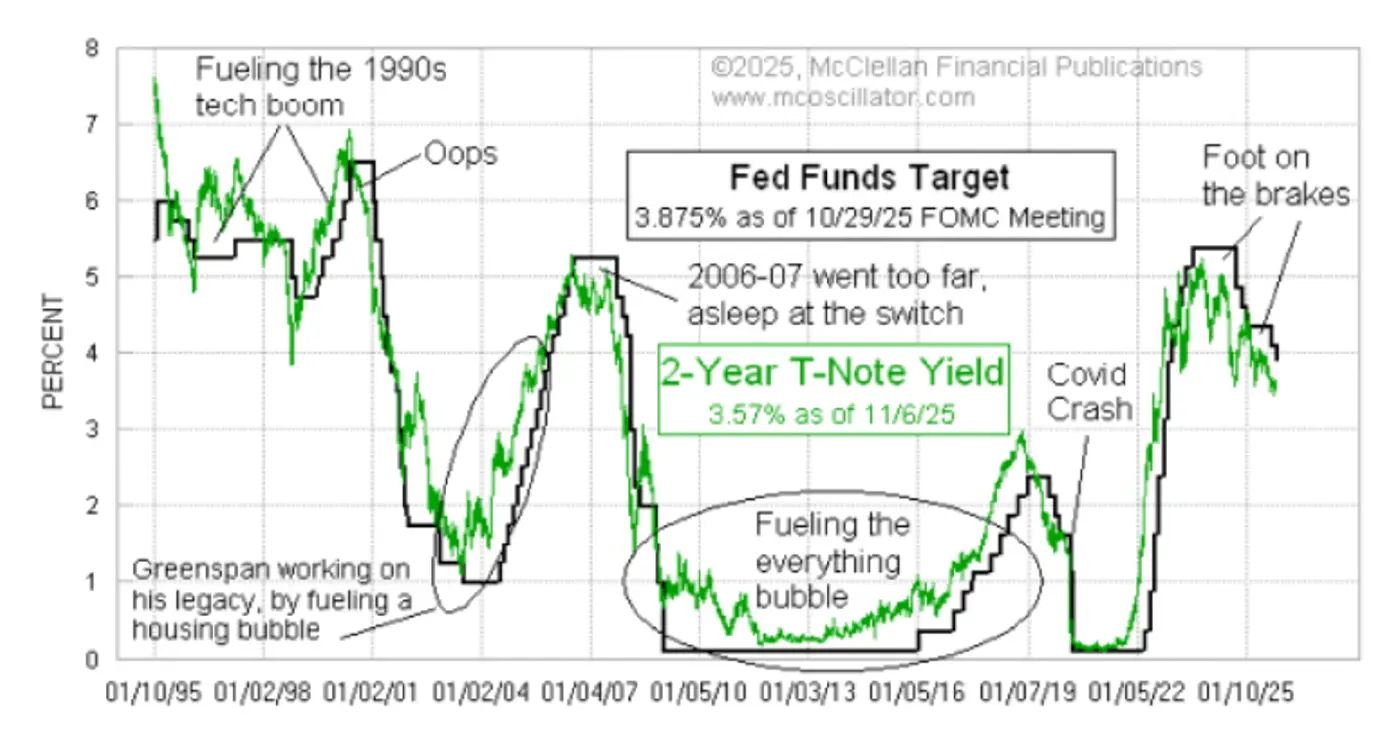
My standard for “too high” is the two-year U.S. Treasury-note yield, shown in the following chart. The two-year yield knows better than the 400 economists working at the Fed about what the Federal Open Market Committee (FOMC) ought to do with its target rate. The committee makes big mistakes when it thinks it knows better than the silly old bond market.
TRACKING THE TWO-YEAR TREASURY-NOTE YIELD VERSUS FED FUNDS RATE
Source: McClellan Financial Publications
 Related Article: Is there a ‘right’ federal funds rate?
For the past three decades—during which the FOMC has used the federal funds target rate as its monetary policy instrument—the committee has almost always lagged behind the message of the two-year yield. It is either too slow to hike rates in good times or too slow to cut them. The two-year yield always seems to know. By maintaining either a positive or negative spread between the two-year yield and the federal funds target rate, the Fed fuels bubbles and recessions.
If I had my way, the FOMC would just outsource the task of setting the federal funds target rate to the two-year yield. That would save the cost of flying all of the district presidents and other members of the FOMC to the eight meetings they hold per year—and we would get better results.
As a side note, before the early 1990s, the Fed targeted the discount rate for its monetary policy, something that rarely gets attention these days. Because of that policy change, extending this comparison back further than what is presented in the chart would not be valid.
The FOMC is finally starting to cut rates now, but the pace has been too slow, and the committee continues to maintain the negative spread between the two-year yield and the federal funds target rate. Think of that negative spread as the Fed keeping its foot on the economy’s brake pedal. We are now seeing the results of all that prolonged braking force over the past two years. The media may blame other agencies and causes for the economic slowdown, but, in my opinion, it is the Fed’s fault.
This is an edited version of an article that first appeared at McClellan Financial Publications on Nov. 6, 2025.
The opinions expressed in this article are those of the author and the sources cited and do not necessarily represent the views of Proactive Advisor Magazine. This material is presented for educational purposes only.
 Tom McClellan is the editor of The McClellan Market Report newsletter and its companion, Daily Edition. He started that publication in 1995 with his father Sherman McClellan, the co-creator of the McClellan Oscillator, and Tom still has the privilege of working with his father. Tom is a 1982 graduate of West Point, and served 11 years as an Army helicopter pilot before moving to his current career. Tom was named by Timer Digest as the #1 Long-Term Stock Market Timer for both 2011 and 2012. mcoscillator.com
RECENT POSTS