Our method for building wealth with purpose
Our method for building wealth with purpose

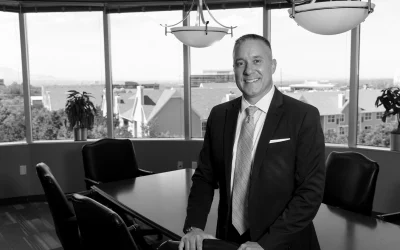
Brett Jenson • Salt Lake City, UT
Method Wealth • Osaic Wealth Inc.
Read full biography below
Proactive Advisor Magazine: Brett, what motivated you to become a financial advisor?
My faith and family have always inspired me to help people. I initially thought I would do that through medicine. I entered the University of Utah as a pre-med student, working toward medical school. By my junior year, I began to question whether that was the right long-term fit for me and the kind of family life I wanted.
I have always been interested in how people make thoughtful decisions with the resources they have. My parents were educators, and they were disciplined and made good financial decisions. We never felt that we went without. That has made a lasting impression on me.
I changed my major to finance and took a position with Fidelity Investments on their trading desk while I was still in school. I came to see financial planning as a way to directly help people—collaborating with clients to make better decisions and improve their quality of life. Quickly, that evolved into a strong belief in comprehensive, fee-based planning and in building a process that puts the client’s goals first.
 Method Wealth is an independent private wealth planning firm. We are not tied to any specific providers and use a wide range of tools to support clients. Our value is in the planning, coordination, and implementation we bring to a client’s financial life.
Our mission is to help successful entrepreneurs and high-net-worth families gain more freedom of time, money, purpose, and relationships. We often talk about helping clients define, design, and refine their own method for managing wealth and finding “elegant simplicity” on the other side of complexity.
Our structure is designed as a virtual family office. Historically, family offices have served ultra-high-net-worth families with internal staff managing their financial matters and often working with outside professionals. Our model strives to bring that same level of coordination to clients without requiring them to build a traditional family office. We can access robust interdisciplinary resources through Sagemark Consulting as needed to address even the most complex client needs.
We collaborate closely with a client’s existing CPA, attorney, insurance professionals, and other advisors. In many cases, clients have done a lot of good planning over the years, but different pieces were implemented at different times by different professionals. The responsibility for coordinating all of it often falls back on the client. We try to serve as the quarterback—bringing the right people together, identifying gaps, and making sure decisions in each area of their wealth are considered in light of the entire financial picture.
The concerns we often see include wealth preservation, wealth enhancement through tax and cash-flow planning, wealth transfer, risk and asset protection, and charitable giving. For entrepreneurs, business succession or exit planning may be another major area. The specific issues differ from client to client, but the need for coordination is remarkably consistent.
We call our process the Method Wealth Blueprint. It is systematic, but not generic. Every client has different goals, values, family dynamics, assets, and concerns, so the process gives us a consistent way to uncover what is unique about each client.
We start with the qualitative side. One of the tools I value most is what we call a total client profile. We look at several areas: values, goals, relationships, assets, the professional advisors on the client’s team, how the client wants the advisory process to work, and the interests and activities that bring meaning to them. We create what we call a “mind map” that helps us see the client’s total picture.
That is important because financial planning can become too focused on spreadsheets and projections. Those certainly matter, and we use quantitative modeling extensively, but the numbers need context. We want to understand what the client is trying to accomplish, why it matters, who is affected by those decisions, and what their ideal future looks like.
From there, the blueprint moves through discovery and engagement, defining the relevant data and objectives, designing the plan, exploring appropriate strategies, implementing recommendations, and conducting regular progress meetings. We also strongly emphasize educating and preparing the next generation when that is important to the family—often through well-planned family meetings.
Coordination runs through the entire process. Once we understand the bigger picture, we can bring the client’s CPA, attorney, and other professionals into the discussion. That often improves the conversation because now no one is looking at one issue in isolation. They can see how tax, estate, business, investment, risk-management, and family considerations interact with synergy.
Ultimately, our job is to take complexity and organize it into a process the client can understand and act on with confidence.

A good portfolio starts with a clear philosophy rather than a reaction to whatever is happening in the markets. First, we believe clients should be adequately compensated for the level of risk they are taking. Second, the portfolio should provide a high probability of success relative to the client’s goals, time horizon, and overall plan. Third, we want to limit exposure to losses that could be difficult to recover from.
That last point can be especially important for entrepreneurs. A business owner may already have a large concentration of wealth tied to one company or industry. The investment portfolio must be viewed in the context of that broader risk exposure.
We focus heavily on four things we believe we can influence: risk, cost, taxes, and emotions. Risk management involves carefully examining asset allocation, risk tolerance, diversification, and an appropriate blend of strategies. Cost matters, but the lowest-cost option is not automatically the best choice. We look at cost relative to the quality and value of the investment managers or strategies being used. On taxes, we consider techniques such as tax-loss harvesting, direct indexing, and thoughtful asset location. Controlling emotions is critical. An investment policy statement, a disciplined process, and regular reviews can help keep decisions grounded during both strong and difficult markets.
In portfolio construction, we use tools such as efficient-frontier analysis and Monte Carlo modeling, evaluate alternatives when appropriate, and assess whether there is a need for protected or guaranteed income. We are also not dogmatic about active versus passive management. Both can have a role. Passive strategies can provide cost-efficient market exposure, while active management may add value or help play defense in certain environments. The blend should be deliberate rather than a default.
Our independent, open-architecture platform supports that philosophy by giving us flexibility to evaluate different managers and strategies while also focusing on tax efficiency, cost efficiency, and consolidated reporting. The goal is always to hold the portfolio accountable to the client’s objectives.
 Related Article: Outsourcing active management: A competitive advantage for advisors
I hope they would say that they see us as a trusted resource and an advocate—someone who consistently tries to act in their best interest and is willing to help them work through important decisions, not just manage an investment account.
For me, some of the most rewarding moments are when planning creates clarity around a decision that has been weighing on someone. I worked with one client who had spent much of her life raising five children as a single mother while working as a nurse. She had convinced herself that she would have to work forever. We were able to show her through the planning process that she had the financial ability to retire. The appointment ended with tears of gratitude. Giving someone that level of confidence can be incredibly meaningful.
The same is true when we help a family address something they have been worried about but have not fully resolved—estate provisions, long-term-care planning, business succession or an exit, or preparing children and grandchildren to be wise stewards of family wealth.
We want our clients to feel that we are willing to go the extra mile, that they can bring important questions to us, and that we understand their financial decisions in the context of their life and values. Wealth is not just about the numbers. It is about what those resources allow people to do for their families, their communities, and the things that matter most to them. If we can help create clarity and confidence around that, then we are delivering real value.
 Brett Jenson, ChFC, CFP, CIMA, CBEC, is a founder and private wealth advisor with Method Wealth, based in Salt Lake City, Utah. He is affiliated with Sagemark Consulting, a financial-planning network of Osaic Wealth Inc.
Method Wealth helps business owners, executives, professionals, and retirees develop comprehensive solutions for their wealth-management needs. Mr. Jenson’s team operates as a virtual family office, coordinating with clients’ existing advisors.
Mr. Jenson grew up in the Salt Lake City area. His mother was an elementary school teacher, and his father was a teacher and coach before becoming a principal. They emphasized strong values based on respect for others and the principles of their faith.
A talented high school athlete and varsity football quarterback, Mr. Jenson also held youth leadership roles at his school and church. He earned a degree in finance from the University of Utah. After his first year of college, he put his education on hold to serve two years in Italy as a missionary for his church. While in school, he worked for Fidelity Investments on their trading desk.
After graduation, Mr. Jenson worked for a technology start-up before joining The MONY Group. In 2004, he moved his practice to Lincoln Financial Advisors, now part of Osaic Wealth, where he continues his affiliation as an independent advisor. He is an active member of The Resource Group, a nationwide network of top professionals within Osaic. In 2024, he rebranded his practice as Method Wealth.
Mr. Jenson holds the Chartered Financial Consultant, Certified Financial Planner, Certified Investment Management Analyst, and Certified Business Exit Consultant designations. He has served as a subject matter expert for the CFP Board of Standards and participates in peer-to-peer networking through the coaching firm CEG Worldwide. He is also the author of “Blueprint Your Wealth.”
Mr. Jenson and his wife have five children. He enjoys spending time with his family, golfing, playing basketball, coaching youth basketball, staying active outdoors, classic cars, and sports memorabilia. He also takes great satisfaction in giving back to others and serving in his church and community.
Disclosure: Securities offered through Osaic Wealth Inc., member FINRA/SIPC. Investment advisory services offered through Sagemark Consulting, a marketing name for Osaic Wealth. Osaic Wealth is separately owned, and other entities and/or marketing names, products, or services referenced here are independent of Osaic Wealth.
Chartered Financial Consultant and ChFC are registered trademarks of The American College of Financial Services. Certified Financial Planner and CFP are registered trademarks of the Certified Financial Planner Board of Standards Inc. (CFP Board).Certified Investment Management Analyst and CIMA are certification marks of the Investments & Wealth Institute. Certified Business Exit Consultant and CBEC are certification marks of Pinnacle Equity Solutions Inc.
Photography by Glen Ricks
QUICK TIP

“Blueprint Your Wealth”: Five areas entrepreneurs and affluent families should coordinate
Brett Jenson, ChFC, CFP, CIMA, CBEC, is a founder and private wealth advisor with Method Wealth, based in Salt Lake City, Utah. He is the author of “Blueprint Your Wealth: Managing wealth for entrepreneurs and high-net-worth families in an ever-changing world.”
Mr. Jenson writes that entrepreneurs and high-net-worth families often have limited time to address increasingly complicated financial needs. Working with different professionals at different times can create what he calls “a disconnected, checkerboard effect” in their planning. Total wealth planning, he says, looks at the entire financial picture so the pieces work together toward the client’s goals.
His book offers a comprehensive framework addressing five key areas of concern for affluent families:
- Wealth preservation: Maintaining financial independence and managing investments to support that objective.
- Wealth enhancement: Being smarter and more efficient with money, including through tax mitigation and cash-flow planning.
- Wealth transfer: Creating a smooth transition of assets so they can best benefit the people and things that matter most.
- Wealth protection: Building a “shield” through risk-mitigation strategies, liability assessment, and preparation for unexpected events.
- Charitable giving: Maximizing the impact of charitable giving on the community, favored organizations, and the world at large.
Mr. Jenson summarizes the objective this way: “Having a well-coordinated plan can give you more freedom of time, money, purpose, and relationships. … The ultimate goal of all this work is not just to build a larger net worth. The goal is to build a better life.”
RECENT POSTS