Kevin Warsh was confirmed by the Senate last week—in a largely partisan vote—as the next chair of the Federal Reserve.
Warsh is expected to lead his first Federal Open Market Committee (FOMC) meeting on June 16–17, 2026.
Many have speculated that the new Fed chair will take office more inclined to ease interest rates—whether influenced by the Trump administration’s position or his own policy views.
MarketWatch noted the tension Warsh may face between inflation and pressure for rate cuts:
“The debate at the Fed is whether Warsh can prevent the central bank from moving toward rate hikes rather than any cuts, according to a note to clients from Wall Street veteran Ed Yardeni.
“Warsh has made clear in speeches and interviews that he believes we are at the dawn of a ‘golden age’ economy where artificial intelligence is boosting productivity and growth and lowering business costs. He’s said that combination justifies rate cuts despite inflation being above the Fed’s 2% target.”
However, Warsh will have to lead the Fed through an economic environment facing higher inflation—even as the economy continues to grow.
Recent inflation data will discourage interest-rate cuts
Reports released last week on consumer prices and wholesale prices both painted a concerning picture of inflation.
CNBC reported several key points from the May 12 consumer price index (CPI) report from the Bureau of Labor Statistics:
- “The consumer price index rose at a seasonally adjusted 0.6% for the month, putting the one-year pace at 3.8%, the highest since May 2023.
- “Excluding food and energy, the core CPI increased 0.4% and 2.8%, respectively, keeping inflation well above the Federal Reserve’s 2% goal.
- “Though energy and in particular gasoline has been much of the headline story, inflation pressures also came from a variety of other areas.
- “The report also contained bad news for workers, as real average hourly wages slipped 0.5% for the month and fell 0.3% annually.”
FIGURE 1: U.S. CONSUMER PRICE INDEX (YEAR-OVER-YEAR % CHANGE)
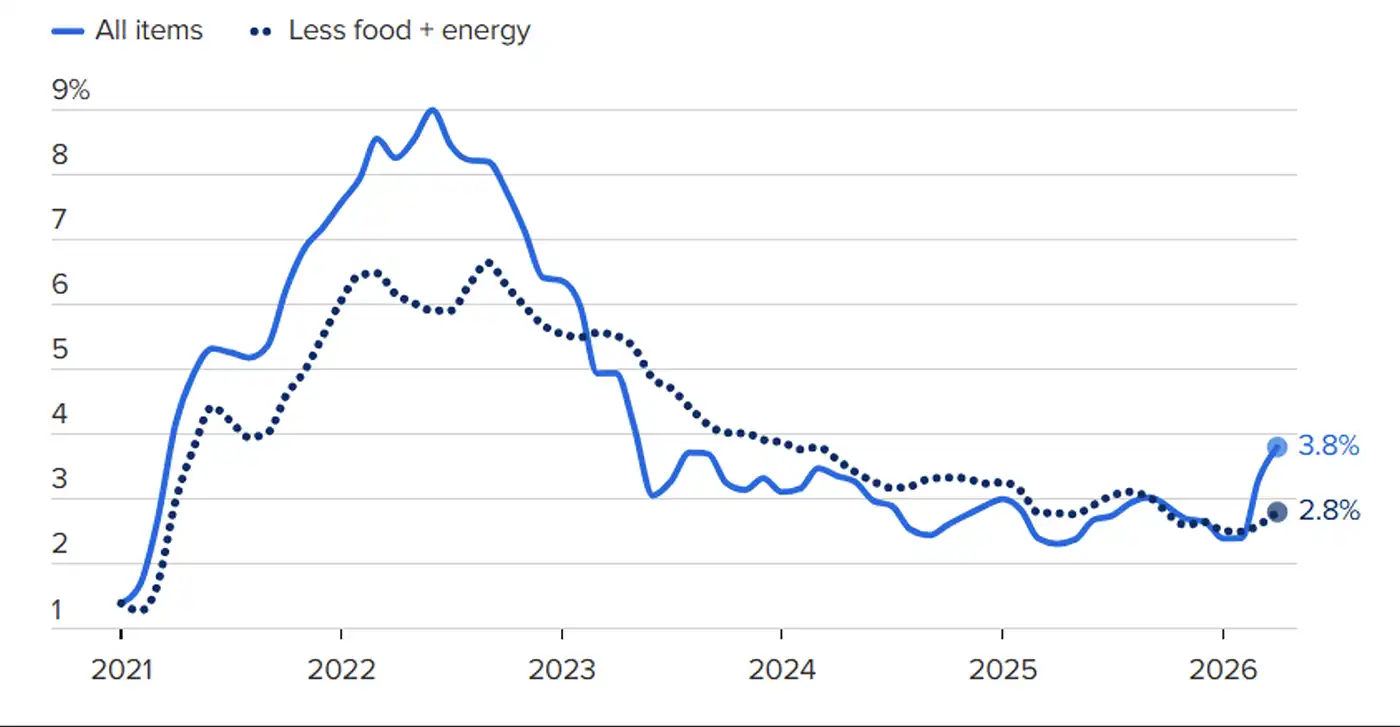
Note: All months are seasonally adjusted except April 2026
Sources: U.S. Bureau of Labor Statistics, CNBC
MarketWatch added more context on the CPI report:
“Consumer prices are likely to keep rising for at least another month or two, economists say, and the inflation rate could top 4% briefly.
“Beyond the next few months, the trajectory of inflation will depend on how quickly the Iran war ends, the Strait of Hormuz is reopened and oil prices decline.”
The other major release last week focused on wholesale prices, which added to inflation concerns.
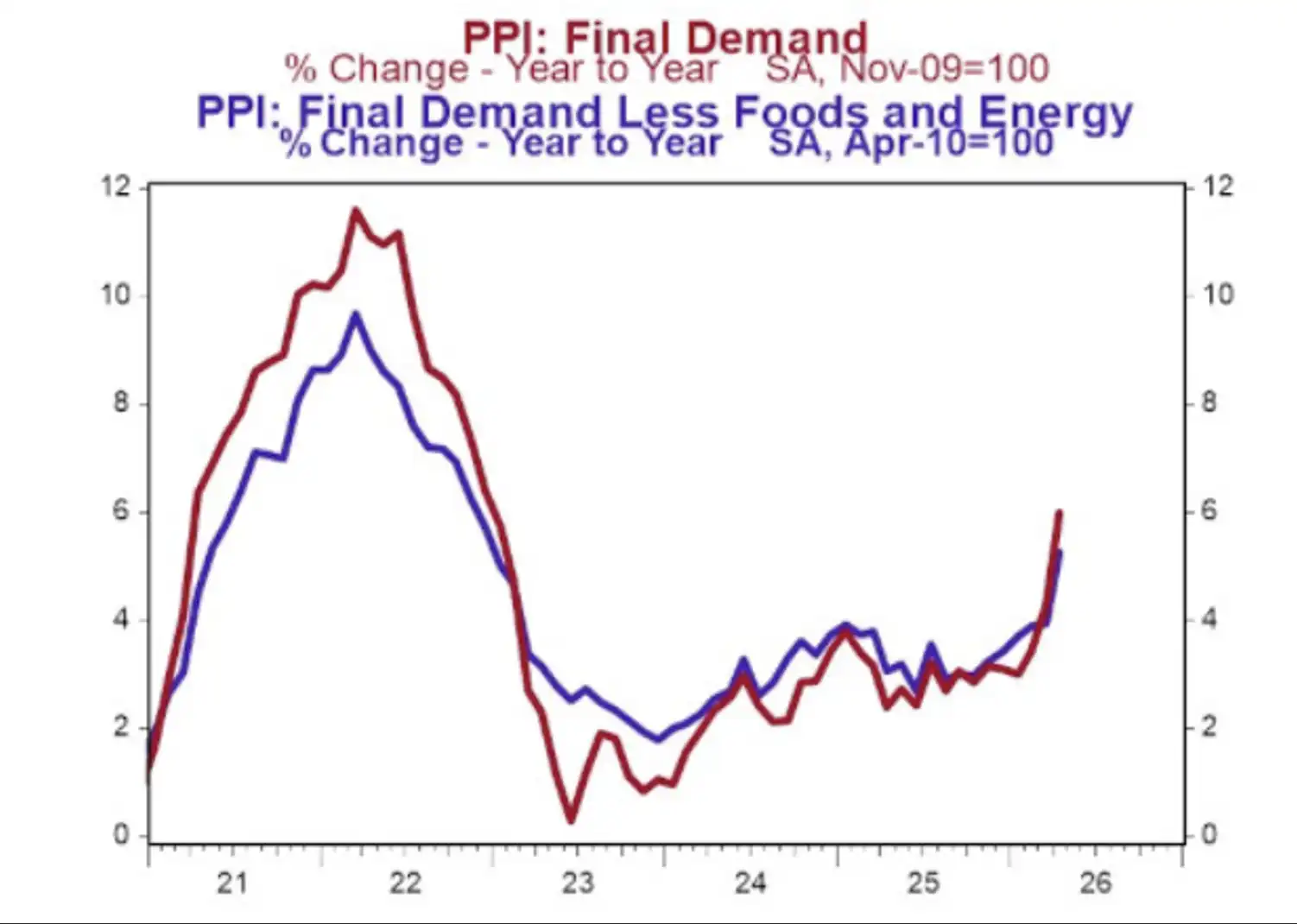
First Trust noted in its analysis of producer price index data,
Key highlights from First Trust included the following:
- “The Producer Price Index (PPI) rose 1.4% in April, coming in well above the consensus expected +0.5%. Producer prices are up 6.0% versus a year ago.
- “Energy prices increased 7.8% in April, while food prices rose 0.2%. Producer prices excluding food and energy rose 1.0% in April and are up 5.2% versus a year ago.
- “In the past year, prices for goods are up 7.4%, while prices for services have increased 5.5%. Private capital equipment prices rose 1.2% in April and are up 5.3% in the past year.
- “Prices for intermediate processed goods increased 2.7% in April and are up 9.4% versus a year ago. Prices for intermediate unprocessed goods rose 4.1% in April and are up 20.9% versus a year ago.”
FIGURE 2: THE PRODUCER PRICE INDEX (PPI) ROSE 1.4% IN APRIL
Sources: Bureau of Labor Statistics, Haver Analytics, First Trust
 Related Article: Do oil price spikes derail stocks?
Economic data show strength beyond inflation
While inflation remains a challenge for the Fed, other recent data points suggest the economy continues to show signs of strength:
- Growth has reaccelerated. Real GDP rose at a 2.0% annualized rate in Q1 2026, up from 0.5% in Q4 2025. The Atlanta Fed’s GDPNow model is also tracking Q2 2026 real GDP at 4.0%, though that forecast is subject to change.
- Consumers are still spending. April retail and food services sales rose 0.5% from March and 4.9% from April 2025.
- The labor market is slower but still holding up. Payrolls increased by 115,000 in April, and the unemployment rate remained unchanged at 4.3%.
- Business activity remains in expansion. ISM’s Manufacturing PMI was 52.7 in April, with new orders expanding for the fourth straight month. The Services PMI was 53.6, also expansionary, with 14 service industries reporting growth.
- Industrial production improved. The Federal Reserve reported that industrial production rose 0.7% in April, manufacturing output rose 0.6%, and business equipment production jumped 1.5%. That points to some renewed strength in the production side of the economy.
- Corporate earnings are strong. FactSet reported that, with 91% of S&P 500 companies having reported Q1 results, 84% beat earnings-per-share estimates, and blended S&P 500 earnings growth was running at 27.7%. If that rate holds, it would be the strongest earnings growth rate since Q4 2021.
Despite these economic positives, Bloomberg notes that a near-term Fed rate cut remains unlikely:
“Investors won’t see a rate cut out of the next Federal Reserve policy meeting, according to DoubleLine Capital LP chief executive officer Jeffrey Gundlach.
“‘People were looking for two rate cuts this year, but the inflation market has simply not cooperated,’ Gundlach said on Fox News’ Sunday Morning Futures. ‘It’s just not possible, in my view, to cut interest rates when the two-year Treasury is almost 50 basis points higher than the Fed funds rate.’
“Newly confirmed as Federal Reserve chair, Kevin Warsh is coming into the role at a ‘rough time,’ Gundlach said.
“With the Iran war sending oil prices surging, which bleeds into US inflation reports, he predicted that the upward trend will continue after the consumer price index jumped 3.8% in April, the fastest pace since May 2023.
“DoubleLine’s models suggest that ‘the next print on the headline CPI is going to start with a four,’ Gundlach said.”
RECENT POSTS