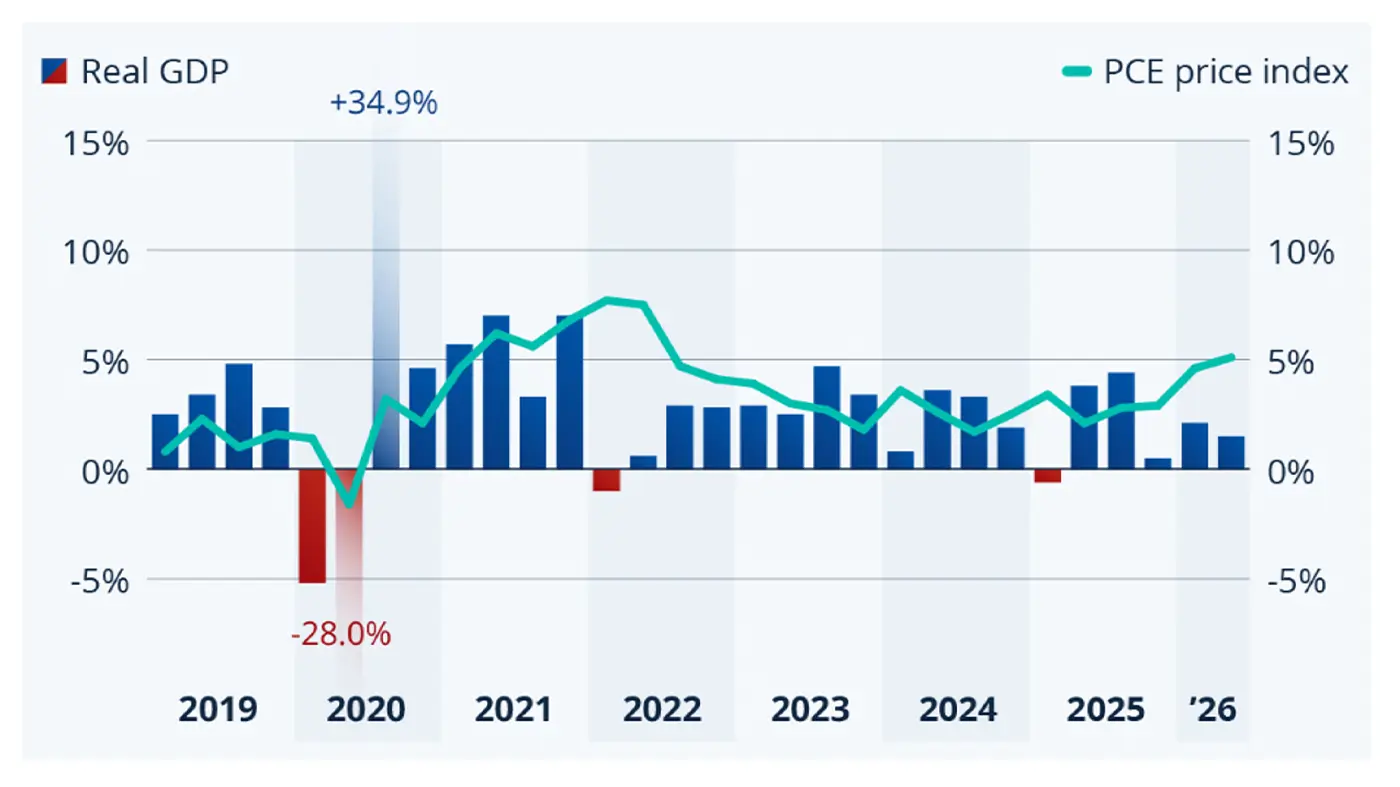
The U.S. economy expanded at a 1.5% annualized rate in the second quarter, according to the Bureau of Economic Analysis’ (BEA’s) advance estimate released last week. That was slower than economists expected and down from 2.1% growth in the first quarter.
To a certain degree, the headline growth number understated the economy’s underlying momentum. A surge in imports, which subtract from GDP, overshadowed a sharp rebound in consumer spending and continued strength in business investment, particularly in technology and artificial intelligence.
The report suggests that while overall growth is moderating, domestic demand remains resilient. That leaves the Federal Reserve with the challenge of balancing a still-expanding economy against inflation that remains above its 2% target.
Highlights from the Q2 GDP report
First Trust identified several key findings from the BEA’s report:
- “Real GDP grew at a 1.5% annual rate in Q2, lagging the consensus expected 2.0% as well as the 2.1% growth rate in Q1.
- “The largest positive contributions to real GDP growth in Q2 came from personal consumption, business investment in equipment, and intellectual property. Home building also eked out a slight gain. The largest drags on growth were net exports and inventories, with small declines for commercial construction and government purchases.
- “Personal consumption, business fixed investment, and home building, combined, rose at a 3.9% annual rate in Q2. We refer to this as ‘core’ GDP.
- “The GDP price index increased at a 6.2% annual rate in Q2 and is up 4.3% from a year ago. Nominal GDP (real GDP plus inflation) rose at a 7.9% annual rate in Q2 and is up 6.5% from a year ago.”
FIGURE 1: Q2 REAL GDP GROWTH AND CHANGE IN THE PRICE INDEX FOR PERSONAL CONSUMPTION EXPENDITURES*
*Both seasonally adjusted at annual rates.
Sources: U.S. Bureau of Economic Analysis, Statista
Did the top-line GDP number understate the health of the economy?
While First Trust called the 1.5% growth “mediocre,” it also found some bright spots:
Beyond the headline number, MarketWatch was encouraged by the results:
“The details of the GDP report underscore just how robust it was.
“Consumer spending, which has the biggest influence, increased at a frothy 3.2% annual rate, compared with a lackluster 0.5% in the first quarter.
“Business spending on equipment, meanwhile, jumped 15% for the second quarter in a row as companies rushed to invest in chips, memory, data centers and other technology tied to artificial intelligence.
“By these measures, the economy was notably stronger in the second quarter than in the first quarter, even though GDP in the first three months of the year expanded at a 2.1% rate.”
Barron’s similarly cited analysts with a positive take on the economy:
“Michael Pearce, chief US economist at Oxford Economics, said the GDP figure was not entirely negative, as it showed non-AI investment had posted its biggest increase in three years.
“‘We expect that recovery to broaden in the coming quarters, driven by tax cuts and lean inventories,’ he said.
“‘The subdued 1.5 percent annualized rise in GDP in Q2 underplays the economy’s strength as it reflects a drag from rising imports and falling inventories that won’t be sustained for long.’”
 Related Article: S&P 500 update: Market breadth improves in the first half of 2026
The administration remains bullish on the economy
National Economic Council Director Kevin Hassett was upbeat about the Q2 GDP results in several press interviews. He said he doesn’t see GDP as a “half-full glass … it’s a full glass.”
“We had a big boom in consumption, a big boom in investment,” Hassett said.
In another interview, he told reporters,
A key takeaway from Hassett’s interviews is that he expects real growth in the 4% range and lower inflation going forward.
Hassett stated that the “surging capital spending, which means there’s downward pressure on inflation because there’s upward pressure on supply, plus CPI [consumer price index] and PCE [personal consumption expenditures], those two reports were about as good as you hope to see if you’re a federal reserve governor.”
“It means the economy is really running on all cylinders,” he concluded.
The Atlanta Fed’s initial GDPNow estimate suggests Hassett’s optimism could be borne out in the third quarter. On July 30, the Atlanta Fed stated, “The initial GDPNow model estimate for real GDP growth (seasonally adjusted annual rate) in the third quarter of 2026 is 5.0 percent on July 30.”
FIGURE 2: EVOLUTION OF THE ATLANTA FED GDPNOW REAL GDP ESTIMATE FOR Q3 2026

Note: The top (bottom) 10 average forecast is an average of the highest (lowest) 10 forecasts in the Blue Chip survey.
Sources: Blue Chip Economic Indicators and Blue Chip Financial Forecasts; Federal Reserve Bank of Atlanta
RECENT POSTS

Passing the baton to the next generation of financial advisors

The age of immediacy—and why investing still requires patience

Committed to clients’ financial clarity and confidence

Existing home sales slide in August, but affordability may improve