Is the ballooning U.S. debt a problem?
Is the ballooning U.S. debt a problem?

Today, many people feel anxious about the growing federal debt. A common worry is that rising interest payments will crowd out other vital government programs and, more importantly, weaken the broader economy. Headlines claiming that government interest payments are approaching $1 trillion have only intensified these fears. Alarming, right?
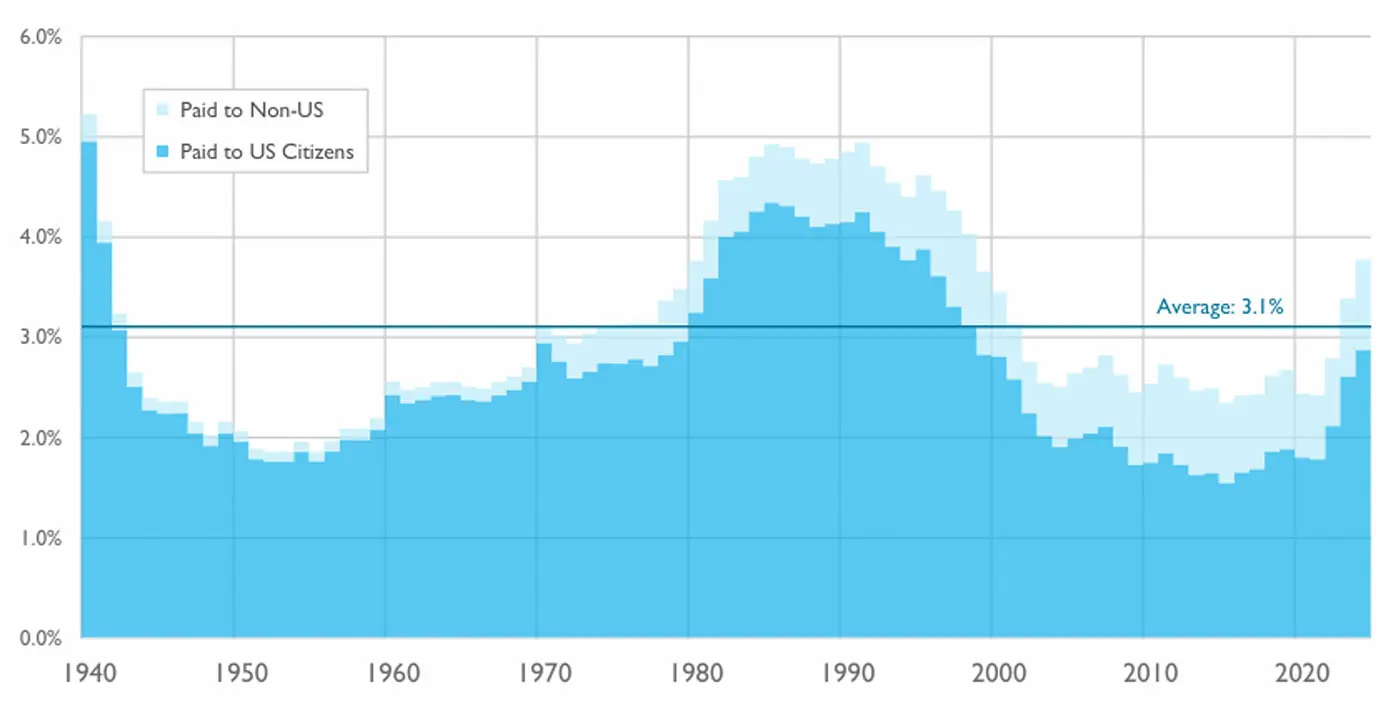
Concerns about rising federal interest payments often overlook key context. Historically, these payments have remained relatively stable as a share of GDP, averaging around 3.1% over the past 85 years. Even during periods of higher interest burdens—such as the 1980s and 1990s—the U.S. experienced strong economic growth. Over the last 25 years, interest payments have generally stayed below average, regardless of economic conditions.
ANNUAL FEDERAL INTEREST PAYMENTS AS A PERCENTAGE OF
US GDP (1940–2024)
Sources: Federal Reserve Bank of St. Louis: FRED; AthenaInvest
In addition, many assume that federal interest payments represent a 100% net expense to U.S. taxpayers, but that’s a misconception. Roughly 75% of federal debt is currently held by U.S. citizens, either directly or indirectly. In effect, interest payments largely serve as income redistribution—tax dollars collected from Americans are used to pay interest to other Americans, and sometimes to the same individuals. Considering this, the majority of federal interest payments function no differently than other federal transfer payment programs such as Social Security or Medicare. For the remaining 25%, foreign ownership of U.S. debt remains modest and has declined since 2010. China currently holds 2% of U.S. federal debt.
From an investment perspective, U.S. federal debt continues to pose little risk, as the government still borrows at some of the lowest interest rates globally. While it is impossible to know when the U.S. federal debt load will become a problem, we do know that the current burden of interest payments is well within historical boundaries set over the past 85 years. Many factors may have an effect on GDP growth, but the size of the U.S. debt isn’t currently the main one.
 Related Article: Can tariffs replace the income tax?
From the behavioral viewpoint
What is going on?
- Availability cascade: We give more weight to information that is readily available or recent, even if it’s not the most relevant or accurate. This is particularly the case today, as news media, investment advertisers, and many online sites allow you, among other things, to track the federal debt in real time.
- WYSIATI—“What you see is all there is”: Daniel Kahneman introduced this cognitive bias to describe the human tendency to make decisions or judgments based solely on the information readily available to them, without accounting for what they don’t know or haven’t considered. Hundreds of thousands of companies fail every year, and in most cases, the only thing we see is the company’s inability to pay its debts. So, we conclude the debt was the problem—not the many business decisions that were the real reasons the company failed.
- Emotional trigger: The idea that “debt is bad” has been pushed since biblical times. No wonder the mere mention of debt and interest payments can trigger a strong emotional reaction. Today, the exhortation “Federal interest payments are approaching $1 trillion!” is ubiquitous and can send our anxious selves into a tizzy.
What can investors do?
- Gain confidence by asking yourself and your financial advisor if there are important investing topics not apparent at the headline level that might be worth exploring.
- Develop a needs-based financial plan as a road map to illustrate the value of long-term investing. Make contributions whenever possible. Be realistic, and review and update the plan regularly as life circumstances change.
- Collaborate with a financial advisor, who can provide valuable perspective and guidance to achieve your goals.
This is an edited version of an article that was first published by AthenaInvest on July 18, 2025.
The opinions expressed in this article are those of the author and the sources cited and do not necessarily represent the views of Proactive Advisor Magazine. This material is presented for educational purposes only.
 C. Thomas Howard, Ph.D., is the director of research and portfolio manager at Quartz Partners Investment Management. Dr. Howard is a professor emeritus in the Reiman School of Finance, Daniels College of Business at the University of Denver. Dr. Howard is the author of the book “Behavioral Portfolio Management” and co-author of “Return of the Active Manager.” Dr. Howard applies behavioral finance principles to investment management and provides educational resources for the financial community.
RECENT POSTS