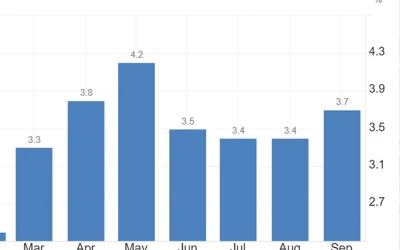
Several recent economic data points suggest a weakening economy, in addition to inflation indicators showing little downward progress.. This puts the Federal Open Market Committee (FOMC) in a difficult position as it considers potential interest-rate cuts—while also facing increased pressure from the Trump administration.
Employment: The labor market weakens sharply
The latest July 2025 Bureau of Labor Statistics (BLS) report showed only 73,000 net nonfarm jobs added, far below economists’ expectations of 100,000 to 115,000. Even more striking: Job numbers for May and June were revised downward by a combined 258,000. That brings the three‑month average to just 35,000 jobs per month, down from 123,000 earlier in the year.
FIGURE 1: U.S. NONFARM PAYROLLS—PAST 12 MONTHS
(INCLUDING REVISIONS)

Sources: Bureau of Labor Statistics, Trading Economics
Unemployment edged up to 4.2% from 4.1%, signaling some slack in the labor market. Wage growth “increased sharply,” says Barron’s, with average hourly earnings up 0.3% month over month, or 3.9% year over year.
Barron’s noted,
“The latest month’s data superficially resemble the year-ago pattern, which saw weaker-than-expected July jobs leading to a bigger-than-expected half-point Fed rate cut. What’s different this time, according to Komal Sri-Kumar, president of Sri-Kumar Global Strategies, is Liberation Day. U.S. companies have been in doubt about how much of the tariffs were going to stick, he said in an interview.
“That uncertainty initially has led to a low level of hiring, but not much firing. So far, sackings haven’t been evident at the unemployment offices. Initial claims for jobless benefits have averaged 221,000 per week over the past four weeks, a historically low level.”
Many analysts viewed this employment report as a turning point. Some economists see it as a game changer for rate‑cut expectations. Tools such as CME’s FedWatch now show about an 80% chance of a September rate cut, up sharply from the mid-30% range before the employment report. Current and former Fed officials have warned that while the labor data doesn’t indicate a collapse, it does reflect a meaningful slowdown—enough to tip the Fed’s policy calculus.
Q2 GDP: A deeper look shows economic growth is lackluster
Despite a 0.5% contraction in first-quarter GDP, the advance estimate for Q2 2025 GDP showed a rebound to 3.0% annualized growth. The gain was led by consumer spending and aided mechanically by a decline in imports. However, weaker investment and exports offset much of that growth.
Beneath the headline number, consumption rose at just a 0.5% annualized rate—sluggish by recent standards. Both exports and fixed investment remain soft. The Atlanta Fed’s GDPNow model has cut its Q3 Nowcast down to about 2.1%, after recent releases show weakened private consumption and investment expectations.
First Trust commented on the Q2 GDP release,
 Related Article: Is lower inflation at risk from tariffs and geopolitics?
The housing market remains soft
Both residential and nonresidential construction have shown persistent softness. Commentary from Raymond James in late July noted that this weakness could significantly affect growth—potentially improving affordability as prices adjust but still acting as a net drag on GDP.
Meanwhile, building permits and housing starts remain subdued, contributing to a cyclical pullback in residential investment. As part of the Conference Board’s Leading Economic Index (LEI), falling housing permits helped push the Index down 0.3% in June and 2.8% over the first half of 2025. That marks the third straight recession warning signal.
The sustained cooling in the housing sector poses risks for both consumer spending and broader investment sentiment.
Raymond James added,
“… Both residential and nonresidential construction spending are declining. This means that the risks of recession are still high today because the buffer that existed back in 2022-2023 is no longer there.
“Recent data on builder sentiment, housing starts, and home sales, but especially on new home sales, all point to a housing market that is weakening again. This is likely the reason the Trump administration is putting so much pressure on the Fed to lower interest rates. However, as we have seen since the Fed started lowering interest rates last year, its effects on mortgage rates have been relatively muted, as the yield on the 10-year Treasury has remained almost unchanged as markets continue to expect higher inflation in the future. Thus, even if the Fed lowered interest rates, there are no guarantees that the yield on the 10-year Treasury and, thus, mortgage rates, will come down any time soon.”
FIGURE 2: CONSTRUCTION SPENDING—RESIDENTIAL AND NONRESIDENTIAL % CHANGE (YEAR OVER YEAR)

Sources: FactSet, Raymond James Economics
ISM surveys: Manufacturing and services show weakness
The manufacturing side of the ISM Report on Business has entered contraction territory; the ISM manufacturing PMI fell to around 48.0 in July, down from 49.0 and below the 50 threshold that separates expansion from contraction.
On the services side, the ISM services index dropped below 50 earlier this summer, hitting around 49.9 in May. That reading also signaled contraction, with new orders particularly soft, backlogs shrinking, and business activity remaining fairly flat. Although some manufacturing data improved slightly in June (new orders at 51.3%), momentum remains fragile across both sectors.
Because ISM data closely correlates with GDP trends, the weakening diffusion and breadth suggest moderation across both consumption and investment channels.
FIGURE 3: ISM MANUFACTURING INDEX—PMI COMPOSITE INDEX

Sources: Institute for Supply Management, Haver Analytics, First Trust
The Fed is under pressure from both sides of its mandate
The Federal Reserve’s dual mandate—maximum employment and price stability—is increasingly under strain, particularly on the employment front. Deep downward revisions to payrolls and a slowdown in hiring have eroded the Fed’s earlier confidence in labor market resilience.
At the same time, inflation remains sticky at around 2.6% annually. Yet signs of cooling demand, anticipated slower wage growth, and reduced job creation suggest inflation may ease—even if very gradually. This weakens the case for keeping rates elevated. Still, uncertainty surrounding the economic impact of newly implemented tariffs argues for caution in cutting rates.
Fed officials—including some regional presidents—have acknowledged signs of slowing economic activity. While recent meeting statements have maintained a “data‑dependent” stance without committing to a rate cut, many analysts now see the weak July employment report as tipping the odds toward a cut “likely sooner rather than later.”
RECENT POSTS