
S&P 500 update: Market breadth improves in the first half of 2026
S&P 500 update: Market breadth improves in the first half of 2026
With the first half of 2026 complete, this edition of “Three on Thursday” looks at the performance of the S&P 500 Index during the period.
Widely regarded as a barometer for the overall stock market, the Index tracks the performance of 500 of the largest companies listed on U.S. stock exchanges. The Index adopts a market-cap weighting approach, allocating a higher percentage of the Index to companies with larger market capitalizations, adjusting for the number of shares available to trade publicly.
The Index delivered a total return of -4.3% in the first quarter of 2026, matching its worst quarterly performance since the first quarter of 2025. It then returned 15.2% in the second quarter, bringing its first-half gain to 10.2%. Market breadth continues to improve. The following three charts provide a fuller picture of the events that unfolded in the first half.
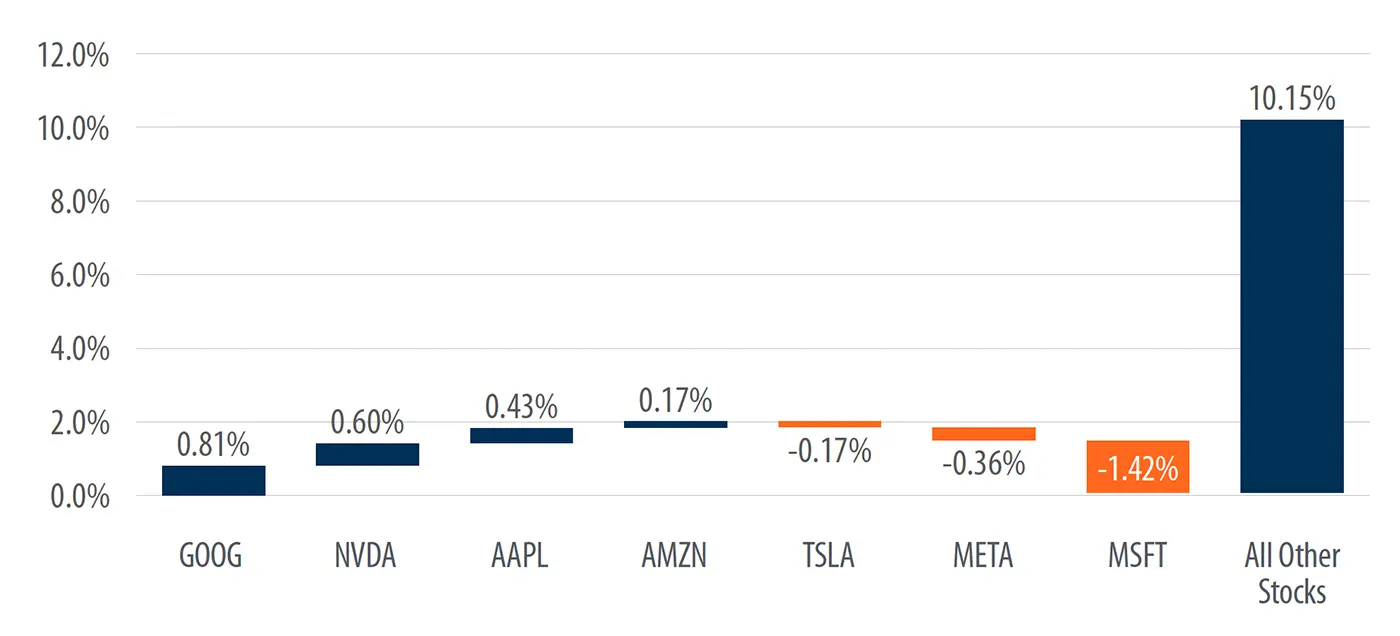
S&P 500 Index return attribution through the first half of 2026
The “Magnificent Seven”—Apple, Nvidia, Microsoft, Amazon, Tesla, Alphabet, and Meta—now account for 33.4% of the S&P 500 Index. But in the first half of 2026, they were anything but magnificent.
Three of the seven posted negative returns, collectively reducing the S&P 500 Index’s total return by nearly 2 percentage points. Microsoft was the biggest drag, falling 22.5% and shaving 1.4 percentage points off the Index’s return by itself. In contrast, the other 493 companies contributed a combined 10.2 percentage points to the S&P 500 Index’s total return.
Sources: Capital IQ, First Trust Advisors. Data from 12/31/2025–6/30/2026.
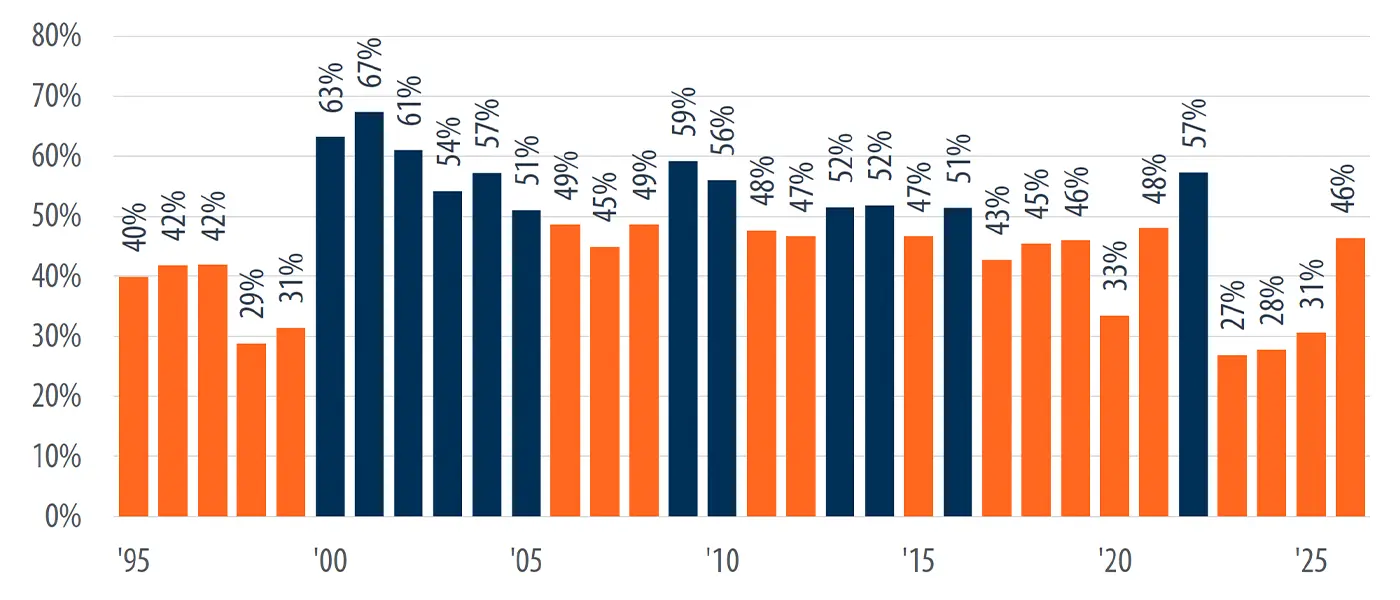
Percentage of S&P 500 Index members outperforming the Index in the first half of 2026
In 2023, just 26.9% of stocks outperformed the Index, the narrowest market since at least 1995. That pattern persisted in 2024 and 2025, when only 27.7% and 30.5%, respectively, beat the Index—one of the most concentrated stretches of market leadership in nearly three decades.
Such narrow leadership hasn’t been seen since the late 1990s, and that period was followed by a meaningful broadening in market participation. A similar shift may now be underway. In the first half of 2026, 46.3% of stocks outperformed the Index.
Sources: Capital IQ, First Trust Advisors. Data from 12/30/1995–6/30/2026.
 Related Article: Do oil price spikes derail stocks?
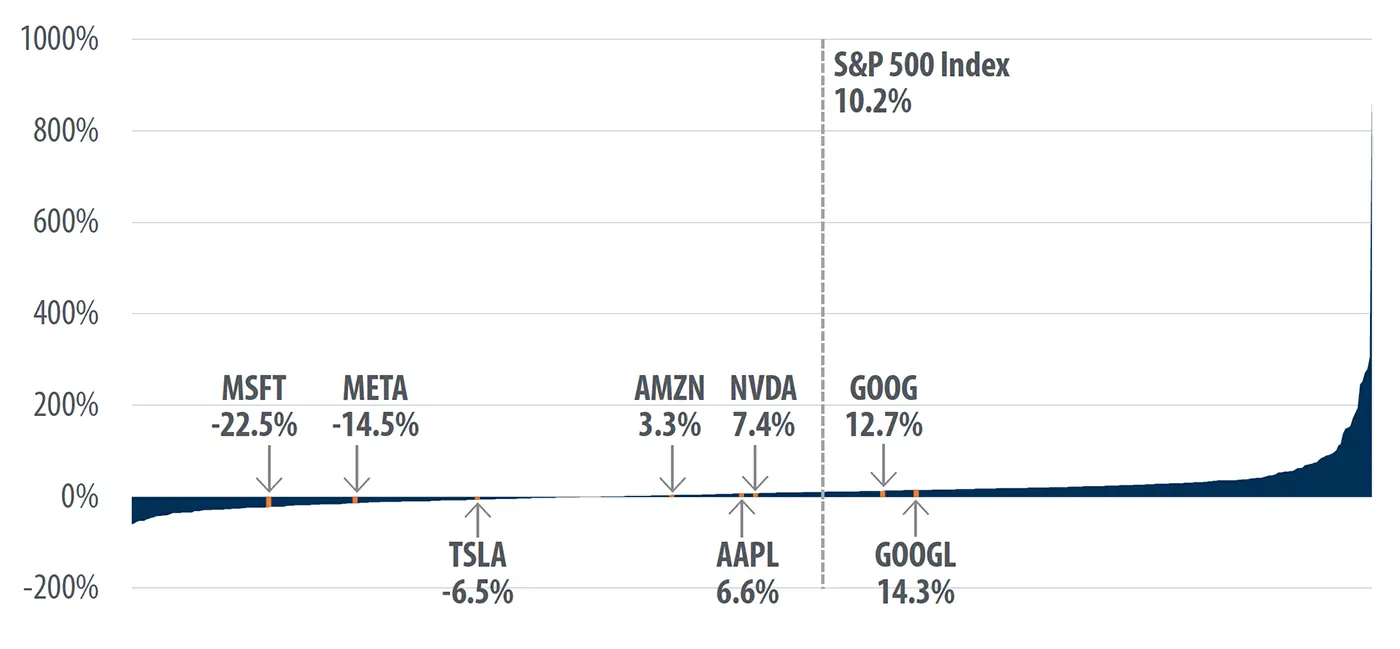
Distribution of S&P 500 stock total returns in the first half of 2026
If you’ve built a well-diversified portfolio, there’s a possibility your performance in the first half of 2026 may have exceeded that of the Index. The reason is that the largest constituents had moderate-to-negative returns, disproportionately pulling the Index lower.
Consider SanDisk Corporation, the top-performing S&P 500 stock in the first half of 2026. Its shares surged 857.8%, but with a weighting of just 0.23%, the stock contributed only 0.5 percentage points to the Index’s return. Meanwhile, Nvidia rose only 7.4% in the first half but carried a roughly 7.8% weighting. It therefore contributed 0.6 percentage points to the Index, more than SanDisk despite its substantially smaller gain.
Equal-weighting all 500 companies would have produced a total return of 12.1%, compared to the 10.2% gain in the traditional market-cap-weighted Index.
Sources: Bloomberg, First Trust Advisors. Data from 12/31/2025–6/30/2026. GOOG and GOOGL represent the Class A and Class C shares for Alphabet Inc., respectively.
Editor’s note: Brian Wesbury is chief economist at First Trust Advisors LP. He and his team prepare a weekly market commentary titled “Monday Morning Outlook,” as well as frequent research reports and the recurring feature “Three on Thursday.” Proactive Advisor Magazine thanks First Trust for permission to republish an edited version of this commentary, which was first published on July 9, 2026.
Past performance is no guarantee of future results. The S&P 500 Index is an unmanaged index of 500 companies used to measure large-cap U.S. stock market performance. Index data is for illustrative purposes only and not indicative of any actual investment. Indexes are unmanaged, and investors cannot invest directly in an index. References to specific securities should not be construed as a recommendation to buy or sell and should not be assumed profitable.
This report was prepared by First Trust Advisors LP and reflects the current opinion of the authors. It is based on sources and data believed to be accurate and reliable. Opinions and forward-looking statements expressed are subject to change without notice. This information does not constitute a solicitation or an offer to buy or sell any security.
The opinions expressed in this article are those of the author and the sources cited and do not necessarily represent the views of Proactive Advisor Magazine. This material is presented for educational purposes only.
First Trust Portfolios LP and its affiliate First Trust Advisors LP (collectively “First Trust”) were established in 1991 with a mission to offer trusted investment products and advisory services. The firms provide a variety of financial solutions, including UITs, ETFs, CEFs, SMAs, and portfolios for variable annuities and mutual funds. www.ftportfolios.com
RECENT POSTS

Every client life stage tells a story. Does your messaging connect to each chapter?

Connecting the pieces of a family’s financial life
Banks set an early positive tone for Q2 earnings season

Why I wrote ‘Evidence-Based Investing’