Modeling with the NAAIM Exposure Index
Modeling with the NAAIM Exposure Index

I recently attended the National Association of Active Investment Managers (NAAIM) Uncommon Knowledge conference. NAAIM is a terrific organization that I have become more involved with over the years.
NAAIM has published its NAAIM Exposure Index since 2006. Each Wednesday, NAAIM asks member firms that are active money managers to report a number representing their overall equity exposure as of that day’s market close. Responses can vary widely, from 200% leveraged short to 200% leveraged long. They are tallied and averaged to show the average long (or short) position of NAAIM managers as a group. As NAAIM clearly states, “It is important to recognize that the NAAIM Exposure Index is not predictive in nature.”
Nonetheless, I did some research a few years ago on the Index to determine whether the numbers might be valuable as part of a model.
I found that strongly oversold readings could indicate that the market is so oversold it is ready to rally. I also found that strongly overbought readings are not usually—as some in the industry think—a contrarian indicator. In fact, they often suggest strong momentum that is likely to continue.
A few weeks ago, I had a discussion with some NAAIM members about the Exposure Index: who used it, what they used it for, and where its actual value might be.
So I decided to revisit my old research and see if I could create a model based on those concepts that could demonstrate the value the Index provides. The results came out better than anticipated. The following chart provides a look at the profit curve of the model versus the S&P 500.
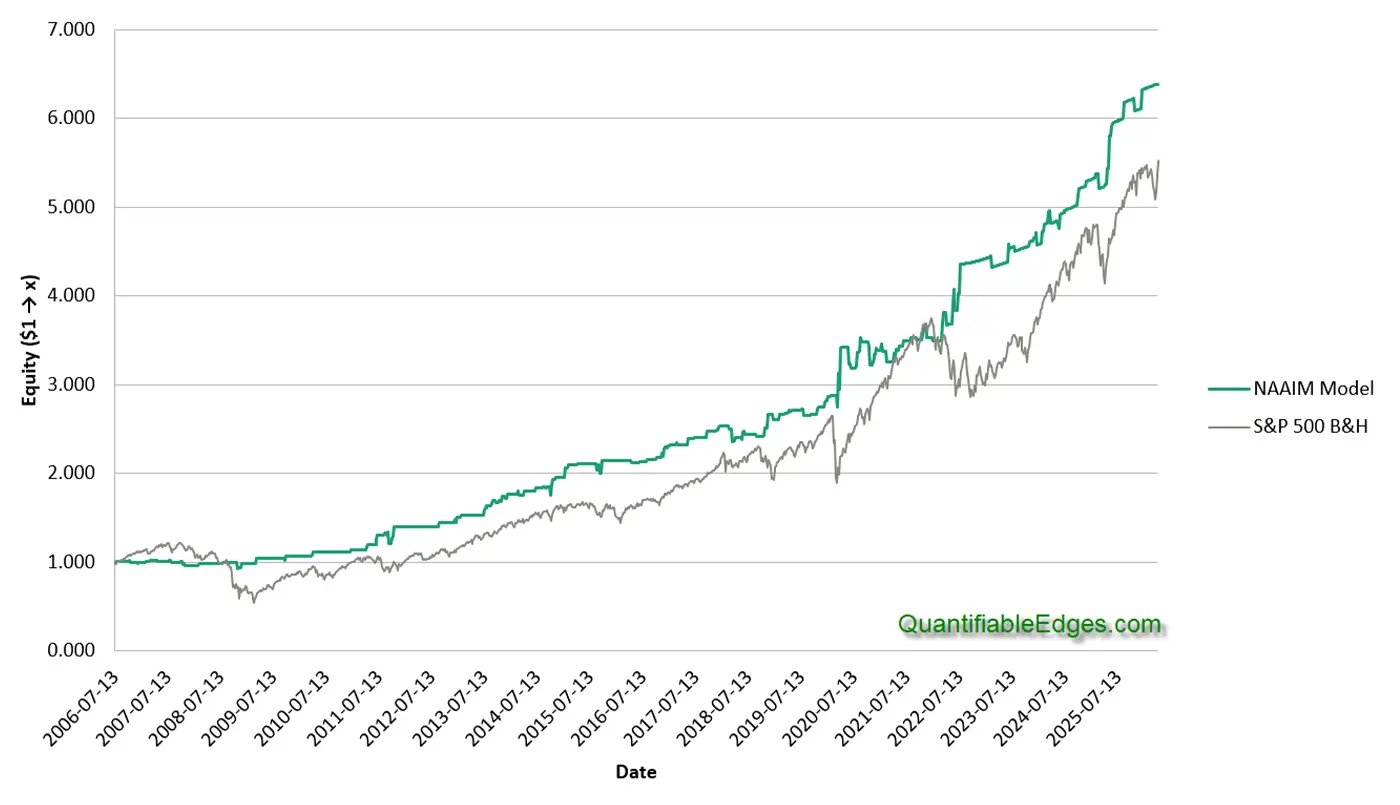
Source: Quantifiable Edges. Data as of 5/6/2026.
The NAAIM Exposure Index is released each week during market hours on Thursday. So the model trades at the close every Thursday afternoon. Thanksgiving and other holidays will sometimes delay the release by one day.
Three setups will cause the model to go long:
- This week’s reading is among the bottom 10% of readings over the last 52 weeks. Additionally, it is not lower than last week’s reading. Essentially, this setup looks for a strongly oversold reading without trying to catch a falling knife. We want to see the Exposure Index near or slightly above where it was the week before.
- This week’s reading is at least 80, and it has risen at least 15 points over the last four weeks. This setup looks for strong and growing enthusiasm.
- This week’s reading is at least 100. As it turns out, when you have a bunch of smart investment managers getting leveraged, there is a good chance that they are right and that market gains are ahead.
If any one of the above is true, the model will go (or remain) long 150% SPX at the close on Thursday. It will remain long at least until the following Thursday, when the new number is published. The following is a statistical table summarizing the results.
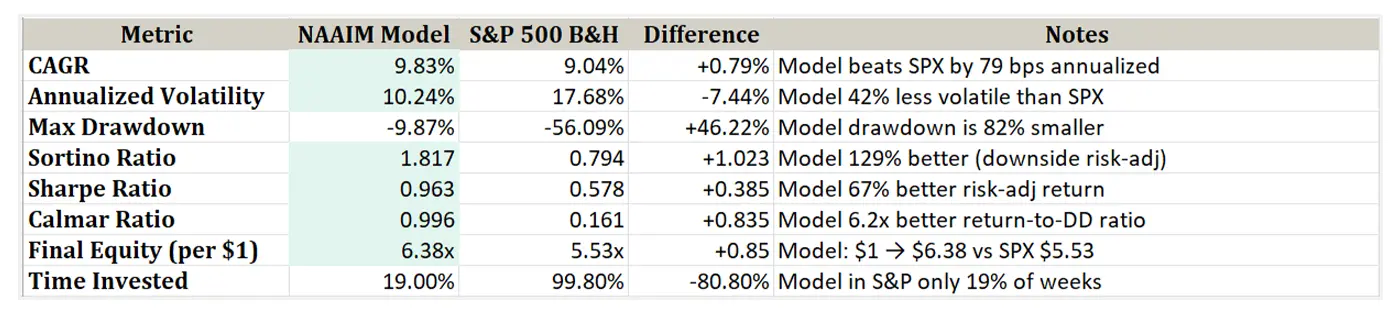
Source: Quantifiable Edges
 Related Article: Should leveraged ETFs be considered for long-term holdings?
The numbers here compare very favorably to the SPX. The model uses leverage when there is an edge and moves to cash when there is not.
As you can see, the model is invested only 19% of the time. That is a big risk reducer. One thing to note is the max drawdown. It is shown as less than 10% in the table above. But that is partly because this model uses only weekly closing numbers. I created a version in RealTest that uses daily pricing. Thanks to March 2020, the max drawdown reached 25% using daily bars—still less than half that of the S&P 500.
Is this a model I would actually trade? No. I don’t think I’d trade any model where I had to hold for a full week based solely on survey results.
Of course, the fact that it is built solely on survey results—and does not take into account price, trend, volume, breadth, or anything else—is what really demonstrates the value of the NAAIM Exposure Index. And that was kind of the whole point. Trading solely on the Index may be overenthusiastic, but using it as one input within a larger model seems completely reasonable and could very possibly strengthen it.
Note: I have the model available in both Excel and RealTest format. If you have a username and password at Quantifiable Edges, you can download the model from the Other Code and Spreadsheets page. If you don’t have a login, you can get one by signing up for a free trial. And if you don’t want a free trial right now, just join our email list and you will receive a copy.
Disclaimer: The performance shown above is hypothetical and does not represent an actual trading account. Results were generated frictionlessly, meaning they do not include commissions, slippage, or other costs that would be incurred in live trading. Past performance, actual or hypothetical, is no guarantee of future results.
This is an edited version of an article that was first published by Quantifiable Edges on May 6, 2026.
The opinions expressed in this article are those of the author and the sources cited and do not necessarily represent the views of Proactive Advisor Magazine. This material is presented for educational purposes only.
 Rob Hanna has worked in the investment industry since 2001. He is the founder and publisher of Quantifiable Edges, a quant-based website where he also publishes a newsletter. After managing a private investment fund through Hanna Capital Management LLC from 2001 to 2019, Rob joined Capital Advisors 360, where he now serves as a registered investment advisor and focuses on short-term and quantitative strategies. QuantifiableEdges.com
RECENT POSTS