
John Grace • Westlake Village, CA
Investor’s Advantage Corporation • LPL Financial
Whether I’m speaking with prospective clients, writing articles, or making a media appearance, my message about our firm’s mission is the same: Preparation beats prediction when it comes to investments.
Learning from history is priceless—yet investors seem determined to relearn the same lessons the hard way.
You’ve probably never heard of Jesse Livermore. He ran away from home with just $5, became one of the most legendary traders of all time, and made (and lost) several fortunes.
Livermore was famous not for prediction, but for self-awareness, understanding how behavior and emotion drive decision-making. He saw patterns others missed.
In his 1923 classic “Reminiscences of a Stock Operator,” Livermore wrote, “There is nothing new in Wall Street. There can’t be because speculation is as old as the hills. Whatever happens in the stock market today has happened before and will happen again.”
Livermore made the equivalent of about $1.5 billion betting against the market in 1929.
Before his final bankruptcy in 1940, he was also remembered for another timeless line: “I made a fortune getting out too soon.”
That quote feels especially relevant today in what I described in an October 2025 Yahoo Finance interview (with a nod to President Herbert Hoover) as “the orgy of everything.” When everything is making new highs, risk hides in plain sight.
In that interview, I suggested bitcoin may have peaked and could seek lower ground, and that other assets at all-time highs—including stocks, real estate, gold, and silver—could eventually follow in a Titanic-style fashion. History shows excess rarely deflates gently.

Meanwhile, before the Iran conflict began at the end of February, stock-market optimism was nearly unanimous (and could be again very soon). Even perennial bulls will admit the lack of dissent is unsettling. As the saying often attributed to General George Patton goes, “If everyone is thinking alike, then somebody isn’t thinking.”
Here’s the bigger risk lurking in the shadows: retirees. Older Americans now own roughly 80% of the stock market, and unlike younger investors, they may not have time to recover from a significant drawdown. Vanguard’s forward-looking forecasts suggest stock returns over the next decade could be far lower than in the past one, a dangerous setup for anyone taking withdrawals.
There are consequences to complacency: overconfidence, overconcentration, ignored volatility, and forced selling at the worst possible time. Remember, there were two market declines of roughly 50% within the same decade. Who can weather that while withdrawing annually?
 Related Article: From Aristotle to active investment management
As Warren Buffett has reminded us: “Predicting rain doesn’t count. Building arks does.”
Investor’s Advantage Corporation has four key principles that form the foundation of our “Crash Ark” for clients:
- Define acceptable loss in percentage terms.
- Build and monitor portfolios to respect that limit.
- Use active management; static accounts won’t adapt.
- Add alternative investments for greater diversification.
Using active investment management is perhaps the most critical of those four steps.
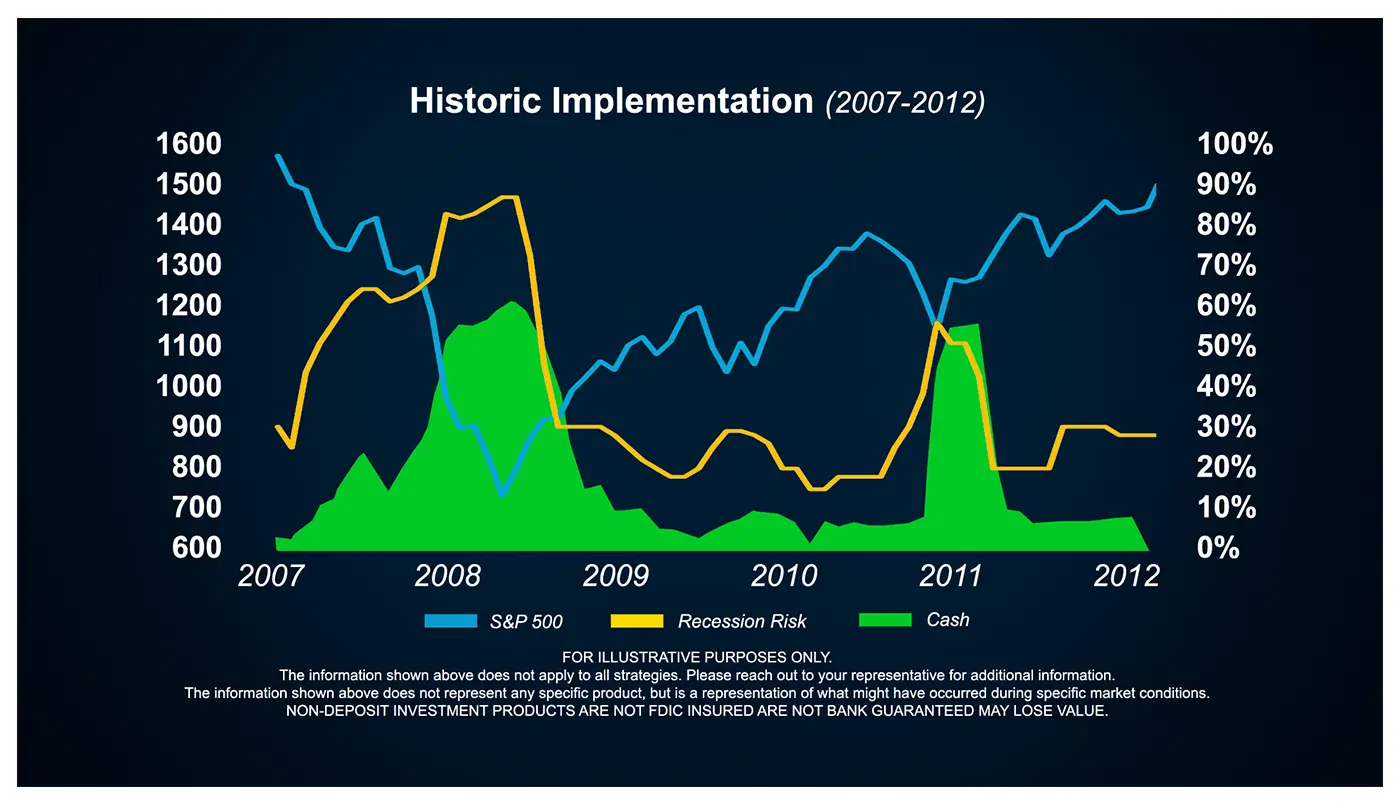
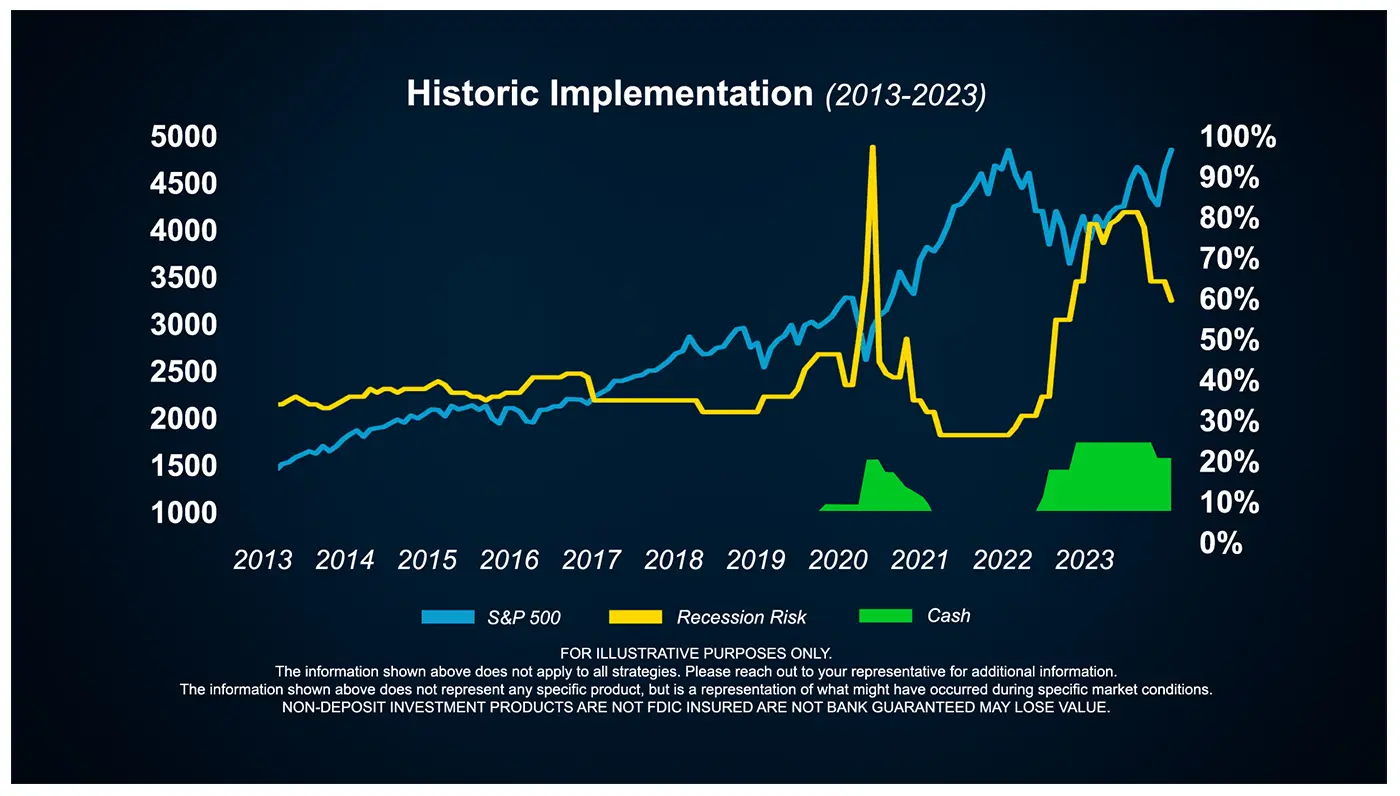
The following charts show that when recession risk rose (yellow) and the stock market declined (blue), investors were able to limit losses through active management strategies put in place in advance.
These strategies moved money from risk assets (equity shares) to safety in cash (green). Active management put the brakes on investor losses in 2008, 2022, and Q1 2025. Telling investors to live with losses is defeatist. We discuss these charts with our clients so they can see the difference between active and passive investment approaches.
Source: Investor’s Advantage Corporation
Source: Investor’s Advantage Corporation
Even with heightened geopolitical risk, the broad bullish market trend remains intact for now, according to most of the securities industry—but it can change in a heartbeat. Several economists warn that price-to-earnings ratios north of 20 leave room for a 60% drop in the S&P 500 and 80% or more in the NASDAQ in a genuine market reset.
In our opinion, no matter how strong markets appear at any given time, there’s no good time to be strictly passive when managing a client’s investment portfolio.
Disclosure: Securities and advisory services offered through LPL Financial, a registered investment advisor. Member FINRA and SIPC.
Photography by Susan Sheridan