Is there a problem with bitcoin? Or is understanding bitcoin the problem?
Is there a problem with bitcoin? Or is understanding bitcoin the problem?

There are several ways advisors can effectively cope with the ongoing bitcoin obsession, their crypto-interested clients, and an asset that lost half its value in a few months.
Significant gains—even fortunes—have been made by investors who were early adopters of bitcoin—or have been prescient in finding excellent buying points during its volatile history.
However, as the price of bitcoin dropped under $70,000 in early March of this year, down 46% from its fall 2025 peak above $126,000, the usual question surfaced from anxious investors: “What’s wrong with bitcoin?”
When a major global asset loses nearly half its value in three months, there must be an explanation—right? Even an unpleasant one can offer some comfort—and a framework for deciding what to do next.
Not this time.
This one stumped even the media. Typically quick to assign a cause, journalists came up short. There was no major hack, no unusual code alteration, no failed exchange, and no forced institutional liquidation. Crypto pundits labeled it another “crypto winter”—a convenient but deceptive and ultimately empty explanation.
The media even turned to its audience. A Feb 5. CNN article asked, “No, but seriously: What’s going on with bitcoin?” A Feb. 6 CNBC headline read, “Bitcoin gets slashed in half. What’s behind the crypto’s existential crisis.” An article from The Wall Street Journal from the same day was even more direct: “A New Crypto Winter is Here and Even the Biggest Bulls Aren’t Certain Why.”
These are not comforting words to investors who just had a chunk of their portfolios disappear—or for financial advisors asked to explain why. If an asset can lose half its value for no apparent reason, how are financial advisors supposed to respond?
In reality, the question itself may be misguided. Asking what’s wrong with bitcoin is like watching an outfielder miss a routine catch and asking what’s wrong with the ball. It reflects a misunderstanding of the asset.
During past bitcoin drawdowns (see chart), there were convenient explanations—hacks, a pandemic, or exchange failures. The absence of a clear catalyst this time underscores the nature of crypto as an asset class: It has no anchor to a conventional valuation model. Most importantly, it isn’t an equity. The more investors treat it like one, the more disconnected they may become from how cryptocurrencies actually behave.
MAJOR BITCOIN DRAWDOWNS: 2016–2026
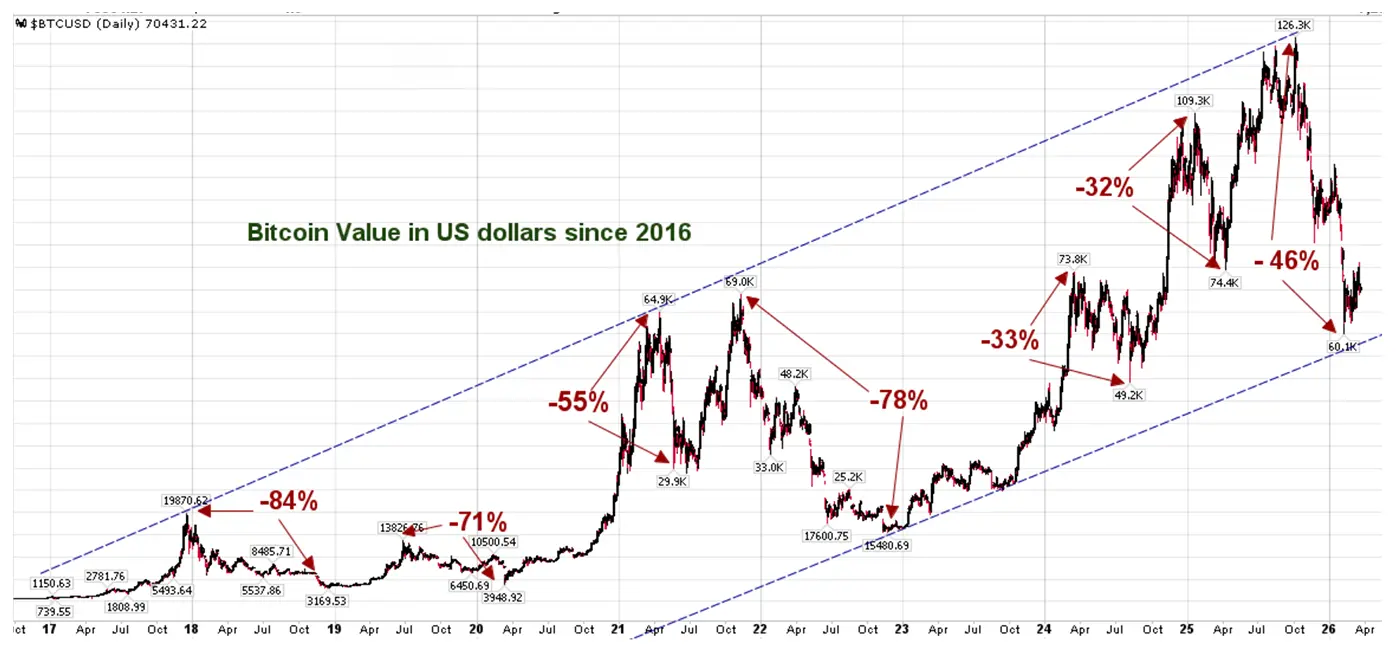
Sources: StockCharts.com. Annotations by the author.
Advisors can parrot the long-term bullish narrative or dismiss the recent decline as another “crypto winter,” but the problem is likely to recur. It may be time to reset expectations around bitcoin’s valuation to help reduce the anxiety that comes with its hyper-volatility. With that in mind, here are seven tips to help advisors guide clients through it.
1. Accept that bitcoin is not an equity
One of the biggest side effects of the crypto mania is that millions of retail investors now own bitcoin without ever having owned an alternative asset. Many likely allocated money that otherwise would have gone into a speculative stock, supporting their perception that bitcoin can be viewed in that context.
This will inevitably lead to problems when bitcoin fails to act or perform like an equity, which is often the case.
According to a WisdomTree research report, from 2012 to 2023, bitcoin’s correlation with the S&P 500 index on rolling 50-day periods ranged from -0.4 to just under +0.5, with most observations between ‑0.1 and +0.2. While the correlations have risen somewhat over time (presumed to be a consequence of increased institutional adoption), the overall correlations with equities are generally quite low. In its early years, bitcoin was even viewed as a potential portfolio diversifier.
This should not be surprising. Bitcoin lacks the characteristics used to value equities, such as an underlying business, equity growth, dividends, or earnings. It must instead be viewed through a different lens—one shaped less by measurable fundamentals and more by the bitcoin narrative, which is both perceptual and subject to change.
WisdomTree also found that, compared with eight other major asset classes for annual performance, bitcoin exhibited a “very much all-or-nothing type of behavior”—ranking either as the top or bottom performer by a wide margin.
Unfortunately, this leaves bitcoin investors and advisors without a clear picture of how bitcoin should be expected to perform relative to an equity portfolio—or how much of an allocation makes sense. Consequently, investors who view bitcoin as the equivalent of, say, a volatile small-cap stock will find that it does not perform like one more than half the time.
2. Acknowledge that behavioral factors are what drive bitcoin’s price—and that they are not always explainable
It is important to distinguish between fundamental and behavioral influences on asset prices while recognizing that both play a role, albeit at different times and to varying degrees.
Bonds are priced largely on fundamentals, such as prevailing interest rates. Their fixed coupons and maturities allow time-value-of-money models to price them with a high degree of accuracy. Equities also have robust valuation models based on fundamentals. However, subjective views of their prospects and macro trends allow behavioral factors to exert considerable influence on prices over the near term.
No valuation models exist for bitcoin because there are no equivalent fundamentals on which to build them. That leaves supply and demand as the sole mechanism affecting price. With supply controlled, bitcoin’s price movements are a function of demand.
Since bitcoin’s original conception as an alternative currency has not fully materialized, it is often viewed as a “store of value” (a fancy way of saying that it is bought more or less for speculation). Demand is driven by behavioral factors such as greed, fear, FOMO, or optimism—none of which can be accurately or consistently predicted.
These emotions are tied to investor conviction in bitcoin’s narrative, including its institutional adoption, acceptance by U.S. regulators, still-limited use as a currency, and core role in the growing decentralized finance ecosystem (even though it is only one small part of that ecosystem). All of this is commonly accompanied by overwhelmingly bullish price projections, generally based on adoption rates thus far and the expectation that those rates will continue well into the future.
Emotions and perceptions clearly propelled the value of bitcoin to its previous heights. But their unpredictability—and the changing nature of the narrative—also drive its volatility. The asset is still young, and perceptions regarding it are evolving. Its global audience adds further complexity, as cultural differences and geopolitical factors may shape how bitcoin is viewed and supported by different nations.
The bottom line is that bitcoin must be viewed in a behavioral rather than fundamental context. As a result, its price is likely to remain highly volatile, with surprise moves in either direction that may have little or no clear explanation.
 Related Article: Predicting how people and markets will behave is more complicated than we think
3. Get your objectives straight
I’m reasonably confident that most advisors are not happy with hold-on-for-dear-life (HODL) as a long-term investment objective.
We also cannot assume that the prevailing narrative about bitcoin encapsulates all the reasons why people buy it. Moreover, as ownership expands from the retail universe to institutions, objectives are likely to evolve to reflect the differences between those types of investors.
Researchers postulate that at least four strategic objectives may be present among bitcoin investors:
- As a speculative play
- As a safe haven
- As a tail-risk hedge
- As a portfolio diversifier (in addition to, or replacement for, real estate or gold)
The point is not whether any one of these objectives has proven more effective than the others (the results have been mixed) but to highlight a familiar principle: Success cannot be measured against an objective that isn’t explicitly identified up front.
4. Beware the bitcoin cheerleaders
Newsletters and airwaves are filled with prominent voices hyping the crypto story. While some offer caution, many are strongly biased to the bullish side—unsurprising given that their interests are often tied to the success of cryptocurrencies.
In June 2025, Ric Edelman published a white paper on his crypto education website projecting a bitcoin price of $180,000 in 2026 and raising his recommended crypto allocation to 10%–40% of one’s portfolio (that’s not a typo). Edelman founded what became the largest independent financial-planning firm in the U.S. and later created the Digital Assets Council of Financial Professionals, so his opinion carries significant weight.
Around the same time, Matt Hougan, chief investment officer of Bitwise Asset Management, a firm that manages crypto ETFs, projected a 2026 price target of $200,000. Coingecko.com reported in late 2025 that JPMorgan forecast a range of $150,000 to $170,000, Robert Kiyosaki projected $175,000 to $350,000, and Tom Lee (co-founder of Fundstrat) maintained a target of $150,000 t0 $250,000.
Then there is perhaps the biggest bitcoin bull, Michael Saylor, CEO of Strategy, the world’s largest corporate holder of bitcoin. In late 2024, he compared owning bitcoin—even at current prices—to buying Manhattan real estate “100 years ago, 200 years ago, every year for the past 300 years.” He added, “You pay a little bit more than the person that bought Manhattan before you, but it’s always a good investment to invest in the economic capital of the free world.”
The point is that staggeringly bullish projections are out there—and your clients have no doubt seen them. To temper expectations, you may need to establish your own benchmarks and avoid the cheerleaders.
(Note: After forecasting $150,000 to $170,000 for 2026 last year, JPMorgan said of bitcoin in a February 2026 follow-up report, “We don’t currently recommend it as part of a core allocation. … Volatility remains relatively high for a standalone asset, and history suggests bitcoin could contribute outsize risk to a portfolio.”)
5. Creating a long-term plan with bitcoin clients
To get on the same page with bitcoin clients, it can be helpful to develop long-term plans that reflect both their views and yours on bitcoin’s growth prospects, along with what-ifs and contingencies. These plans should incorporate the client’s objectives, risk tolerance, account type, tax status, and other relevant factors.
You now have more than a decade of bitcoin history and extensive research to inform a long-term plan. Not every client wants to hold it forever with no endgame in mind. Bitcoin’s volatility has produced significant highs and lows over that time, creating opportunities to take gains or add to positions.
You don’t need a perfect view of where bitcoin will ultimately end up. Simply sitting down with clients to talk through a plan can go a long way toward reducing unnecessary anxiety.
6. Clear up the advisory ambiguities surrounding bitcoin
Some advisors may not have a clear understanding with clients regarding bitcoin holdings, especially when those assets are held outside the primary brokerage relationship.
Is bitcoin part of the portfolio you manage? Are you charging a fee on those assets? Does it matter whether a client holds bitcoin directly or through an ETF? How does it compare with other cryptocurrencies available to investors? Was there ever a clear discussion about your role in advising on these holdings?
These questions highlight the ambiguities that can arise—and they may not be easy to address. But better to clarify them now than when a client is forced to take a substantial loss on the asset.
7. Be aware of the existential wild card
Many dismiss the potential existential threat quantum computing could pose to crypto assets. But whether or not it ultimately breaks the cryptographic technology underlying bitcoin, the mere possibility of such a calamity may already be weighing on crypto markets.
An asset that can cost tens of thousands of dollars and is highly sensitive to public perception carries a type of tail risk investors often prefer not to think about. It may not matter whether quantum computing poses a real threat—what matters is whether enough people believe it does.
Quantum computing is not yet a practical reality, but significant resources are being invested in its development. The possibility of a technology that could render bitcoin worthless may continue to hang over the bitcoin market until it becomes clearer whether that threat will materialize. And that could be years away.
The purpose of this article is not to take a bullish or bearish stance on cryptocurrencies in general or bitcoin specifically.
Bitcoin will continue to evolve and generate headlines, but the advisor’s role remains constant: to bring clarity, discipline, and context to every investment decision. By understanding both the potential and the pitfalls, advisors can help guide clients through the cryptocurrency noise with a steady, informed perspective. Ultimately, conversations about bitcoin aren’t just about an asset—they’re about aligning decisions with each client’s goals, risk tolerance, and long-term investment plan.
The opinions expressed in this article are those of the author and the sources cited and do not necessarily represent the views of Proactive Advisor Magazine. This material is presented for educational purposes only.
 Richard Lehman is an adjunct finance professor at Cal Poly. He specializes in behavioral finance and financial derivatives, and has authored three books. He has more than 40 years of experience in financial services, working for major Wall Street firms, banks, and financial-data companies.
RECENT POSTS

Passing the baton to the next generation of financial advisors

The age of immediacy—and why investing still requires patience

Committed to clients’ financial clarity and confidence

Existing home sales slide in August, but affordability may improve