

The primary trend of the stock market has always been described as either a bull or bear market: one or the other. But, life is rarely so simple. It could be effectively argued that, just as there are four seasons to the year, there are four seasons to the stock market.
The spring of the year is born from the ravages of winter. The spring of the stock market is born of the ravages of a bear market. During the spring of the year, new green life seems to explode from hibernating seeds. Everything grows at a rate never to be seen again for the rest of the year. In the spring of a new bull market, almost every stock goes up, with the biggest gains made by the small-cap and low-priced stocks. The slowest-growing plants in spring are mighty oaks, and the slowest-advancing stocks in a new bull market are usually large-cap blue chips.
To capitalize on the opportunities available during the spring of the stock market, it is important to get fully invested as soon as possible after a new bull market begins. That probably means finding a money manager who has a documented record of accurately identifying the start of new bull markets. When the time comes, 65% might be invested in small-caps and 35% in mid-caps. Note that this is in direct conflict with the experts who call for “averaging in,” or being half long and half short, or always buying large-caps.
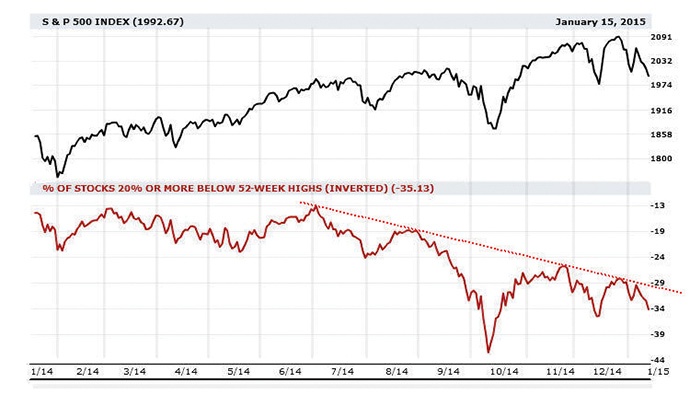
% OF STOCKS MORE THAN 20% BELOW 52-WEEK HIGHS VS. S&P 500
During the summer of the year, plant growth continues but at a slower pace. A few plants die from the hot sun or a lack of water. For the most part, it is too late for major new planting. During the summer of the stock market, large-cap stocks start to join the leadership. This usually calls for a shift in portfolio holdings to say, 40% small caps, 35% mid caps, and 25% large caps. But in the summer, investors must step up their alertness, since some stocks become overpriced, or lose sponsorship and languish. These stocks have to be culled from the portfolio, just as weeds need to be pulled.
In the autumn of the year, the leaves begin to change color, and eventually fall from the trees, one by one. Crops begin to reach full maturity and must be harvested, or they will rot. In the autumn of the stock market, the leadership shifts decidedly to the big caps, as many small caps and mid caps become overpriced and begin to roll over, one by one, into their own bear markets. This requires further realignment of portfolios, moving away from small caps and mid caps, and focusing primarily on large caps for the remaining months of the bull market. As individual stocks fail to rise to new highs with the S&P 500 Index, they must be eliminated, constantly reducing holdings in preparation for the inevitable bear market.
We are now in the autumn of the current bull market. About 44% of small-cap stocks have already dropped 20% or more from their highs, and the current leadership is heavily focused in large-cap stocks. More and more small-cap and mid-cap stocks are rolling over, one by one, into their own bear markets, while the large-cap S&P 500 Index should continue to reach new highs for at least several more months.
Just as the autumn of the year is a constant warning of the approach of winter, the autumn of the stock market is warning that investors should be harvesting fully-ripe stocks to avoid the ravages of the next gradually approaching bear market.
The opinions expressed in this article are those of the author and do not necessarily represent the views of Proactive Advisor Magazine. These opinions are presented for educational purposes only.
 Paul Desmond is the president of Lowry Research Corporation, the oldest continuously published advisory firm in the U.S., founded in 1938. He also serves as chairman of Lowry Capital Management Corporation, was a past president of the Market Technicians Association (MTA) and a founder of the American Association of Professional Technical Analysts (AAPTA). Mr. Desmond and Lowry Research are the recipients of numerous awards for excellence in technical analysis. lowryresearch.com
Recent Posts: