
Major banks set an encouraging tone for the second-quarter 2026 earnings season, with results generally exceeding expectations across trading, investment banking, lending, and interest income.
JPMorgan Chase benefited from strong market activity and higher investment banking fees, with record quarterly profits. Bank of America reported broad-based strength across trading, dealmaking, and net interest income. Wells Fargo also delivered better-than-expected results, supported by loan growth and improved investment banking activity. Citigroup added to the positive start, with improving performance across its institutional and consumer businesses, although its outlook disappointed analysts. Together, the reports suggested that the largest diversified banks entered the quarter with resilient operations and momentum across several important revenue streams.
The strength also extended to the firms most closely tied to Wall Street and capital-markets activity. Goldman Sachs and Morgan Stanley benefited from a rebound in investment banking and particularly strong trading results, reinforcing signs that corporate dealmaking and investor activity have improved. Even so, investor reactions across the banking sector were mixed, showing that the market remains focused on expenses, margins, credit conditions, and whether the recent improvement in trading and dealmaking can continue.
Overall, the banks established a high early bar for the broader group of S&P 500 companies preparing to report second-quarter results.
Barron’s said of the major banks’ results overall, “Many of the same factors have propelled big banks’ strong performance: a solid economic backdrop with low unemployment, corporate clients’ appetite for executing big deals, and lots of trading activity.”
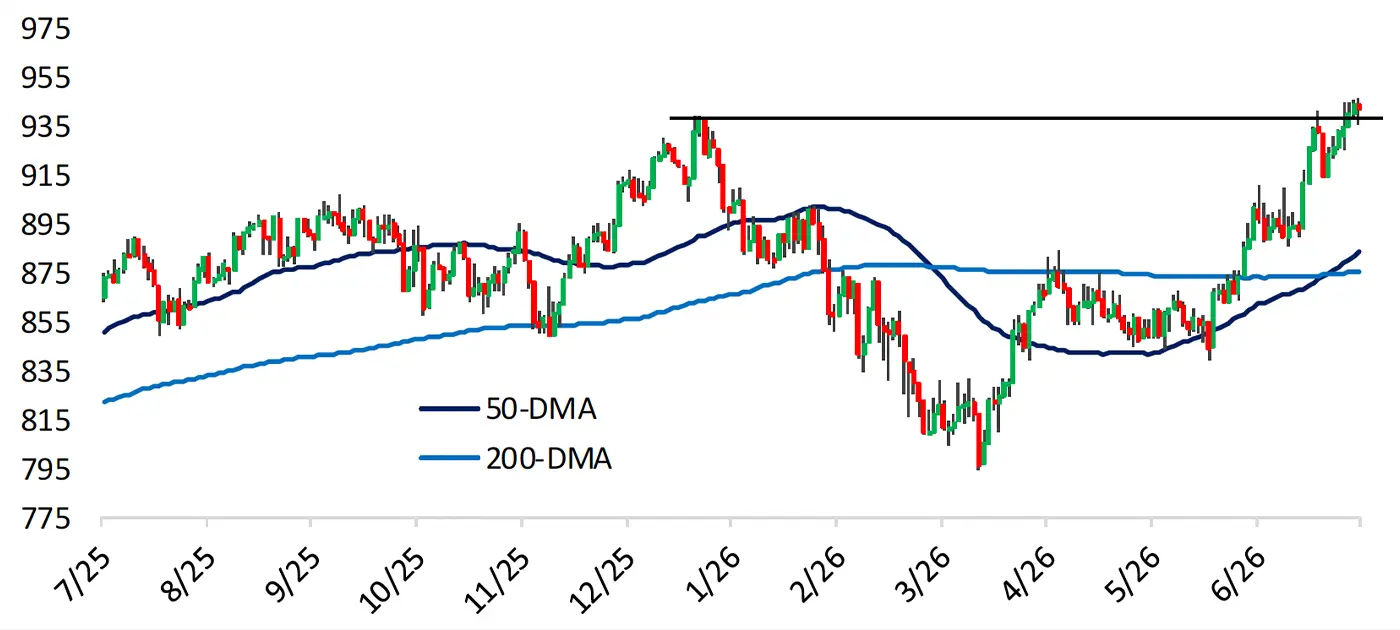
In the run-up to earnings season and continuing into last week’s reports, the S&P 500 Financials sector has been on an extended winning streak.
Bespoke Investment Group analyzed this move higher on July 17:
“With those earnings, the Financials sector managed to touch 52-week highs intraday Tuesday [7/14] but pulled back intraday; it was the sector’s second unsuccessful intraday attempt at new highs in the past week. However, there was follow through and a more material breakout in the back half of the week.
“Looking under the hood, the three industry groups making up Financials have been running hot. For starters, the banks are at or near 52-week highs with 30 straight sessions in overbought territory, the longest streak since April 2024. Financial Services made a higher high too. However, that comes with the sector trading extremely overbought for eleven of the last twelve sessions. In fact, the average overbought/oversold reading in the past twelve days [is] 2.5 standard deviations: the highest since December 15, 2017 and ranking in the 99th percentile of all days since 1990.”
FIGURE 1: S&P 500 FINANCIALS SECTOR—PAST YEAR
Source: Bespoke Investment Group
 Related Article: Retiring boomers broke this important economic relationship
Highlights for Q2 2026 earnings to date
FactSet provided the following overview of early results from the Q2 earnings season, noting the strength of the Financials sector:
“At this early stage, the second quarter earnings season for the S&P 500 is off to a strong start relative to expectations. Both the percentage of S&P 500 companies reporting positive earnings surprises and the magnitude of earnings surprises are above recent averages. …
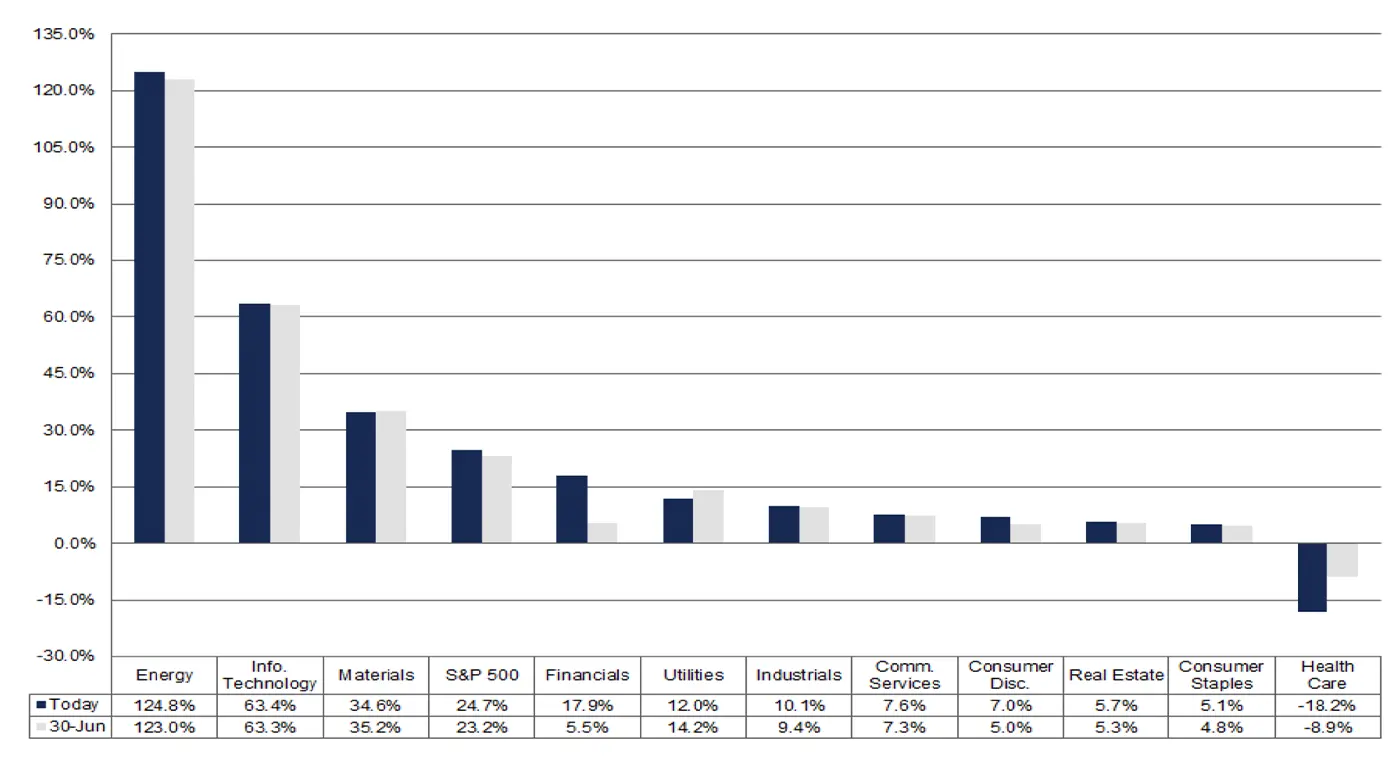
“During the past week, positive EPS surprises reported by companies in the Financials sector were the largest contributor to the increase in the overall earnings growth rate for the index over this period. Since June 30, positive EPS surprises reported by companies in the Financials sector, partially offset by downward revisions to EPS estimates for companies in the Health Care sector, have been the largest contributor to the increase in the overall earnings growth rate for the index over this period.”
In its July 17 Earnings Insight, FactSet shared several key metrics on Q2 earnings progress:
- “Earnings Scorecard: For Q2 2026 (with 10% of S&P 500 companies reporting actual results), 88% of S&P 500 companies have reported a positive EPS surprise and 85% of S&P 500 companies [have] reported a positive revenue surprise.
- “Earnings Growth: For Q2 2026, the blended (year-over-year) earnings growth rate for the S&P 500 is 24.7%. If 24.7% is the actual growth rate for the quarter, it will mark the second-straight quarter of earnings growth above 20% for the index.
- “Earnings Revisions: On June 30, the estimated (year-over-year) earnings growth rate for the S&P 500 for Q2 2026 was 23.2%. Eight sectors are reporting (or are expected to report) higher earnings today (compared to June 30) due to upward revisions to EPS estimates and positive EPS surprises.
- “Earnings Guidance: For Q3 2026, 4 S&P 500 companies have issued negative EPS guidance and 5 S&P 500 companies have issued positive EPS guidance.
- “Valuation: The forward 12-month P/E ratio for the S&P 500 is 20.3. This P/E ratio is above the 5-year average (19.9) and above the 10-year average (19.0).”
FIGURE 2: S&P 500 EARNINGS GROWTH (Y/Y) (Q2 2026)
Source: FactSet
RECENT POSTS

Every client life stage tells a story. Does your messaging connect to each chapter?
S&P 500 update: Market breadth improves in the first half of 2026

Connecting the pieces of a family’s financial life

Why I wrote ‘Evidence-Based Investing’