
Think smarter, not faster: 6 steps to better decision-making through behavioral finance
Think smarter, not faster: 6 steps to better decision-making through behavioral finance

The practical application of behavioral finance principles within the Guggenheim investment process can serve as a useful model for how these ideas can be adapted to any advisor’s practice.
Summary
Financial advisors cite loss aversion and overconfidence as the two most common factors hindering their ability to make the best decisions, while loss aversion, recency bias, and confirmation bias are among clients’ most prevalent cognitive biases. These factors can feed into poor decision-making in an investing context.
At the same time, these and other biases can come into play in all aspects of an asset manager’s investment process or an advisor’s practice management. Guggenheim Investments has built its investment process on these ideas, and a rational, unemotional approach to long-term portfolio planning can also be applied to an advisor’s activities. Slowing the process enables an advisor to focus on the specialized and value-added activities that form the basis of a well-organized and profitable practice.
Cognitive bias: The enemy of good decision-making
Decision-making is an inherently flawed process. Often, we think we are making a rational decision based on experience, but it is frequently shaped by fundamentally incorrect logic caused by cognitive bias. Cognitive biases are systematic errors that occur when people are processing, interpreting, and acting on information that they receive.
Based on a series of groundbreaking experiments, Nobel Prize winner Daniel Kahneman and his colleague Amos Tversky used a metaphor of two systems of behavior that drive the way humans make decisions. System 1 behavior is automatic, rapid thinking, intuitive, and emotional. System 2 behavior is slower, deliberative, effortful, and logical.
Two systems of thinking in behavioral finance
- Based on perception and intuition
- Fast, parallel, automatic, and associative
- More vulnerable to cognitive biases, which can result in inferior decisions
- Based on logic
- Slow, serial, controlled, effortful, rule-governed, and flexible
- Less vulnerable to cognitive biases
- Ideal for investment decision-making
The human mind is capable of generating complex patterns and ideas while making System 1 decisions, but these decisions are typically helped by shortcuts of intuitive thinking, or heuristics, that render us vulnerable to cognitive biases. To be sure, System 1 decisions are not inherently bad: Thinking fast can be a vital component of avoiding danger or recovering from a distraction in the middle of a client conversation. But System 1 decisions are generally not strategic and can easily derail long-term portfolio performance.
Financial advisors cite loss aversion and overconfidence as the two most common factors hindering their ability to make the best decisions. Loss aversion, recency bias, and confirmation bias are among clients’ most prevalent cognitive biases, according to research by Cerulli Associates in collaboration with Charles Schwab and the Investments & Wealth Institute.
Advisors should be aware of how many biases come into play in all aspects of their practices. Studies on behavioral finance tend to focus on investment decisions alone, which we believe misses other situations in which the power of emotional response overcomes the substance of a dispassionate, rational decision. For example, when clients react emotionally to how a headline event may affect their portfolios, their subsequent phone calls to their advisor put pressure on the advisor to act—even if the portfolio was constructed to weather such passing storms.
In effect, a large part of an advisor’s communications involves using System 2 strategies to expediently extinguish a client’s System 1 fires. In a practice management context, an advisor’s fear of offending clients by disagreeing with them or providing contrary advice can be a missed opportunity to educate clients on the likely long-term outcome of making the wrong decision today. This desire to please clients at all costs can also distract an advisor from focusing on investing acumen and long-term planning.
Client preconceptions can vary from generation to generation. Loss aversion is a bigger issue for older clients, while millennial and Generation X clients are more likely to struggle with framing and recency biases. Understanding the differing biases of clients at the start of the asset accumulation process compared to those nearing retirement offers advisors a useful cue in managing the expectations of different demographics. As the following chart shows, advisors cite myriad benefits of incorporating behavioral finance into efforts to forge stronger client relationships.
GREATEST BENEFITS TO ADVISORS OF INCORPORATING BEHAVIORAL FINANCE
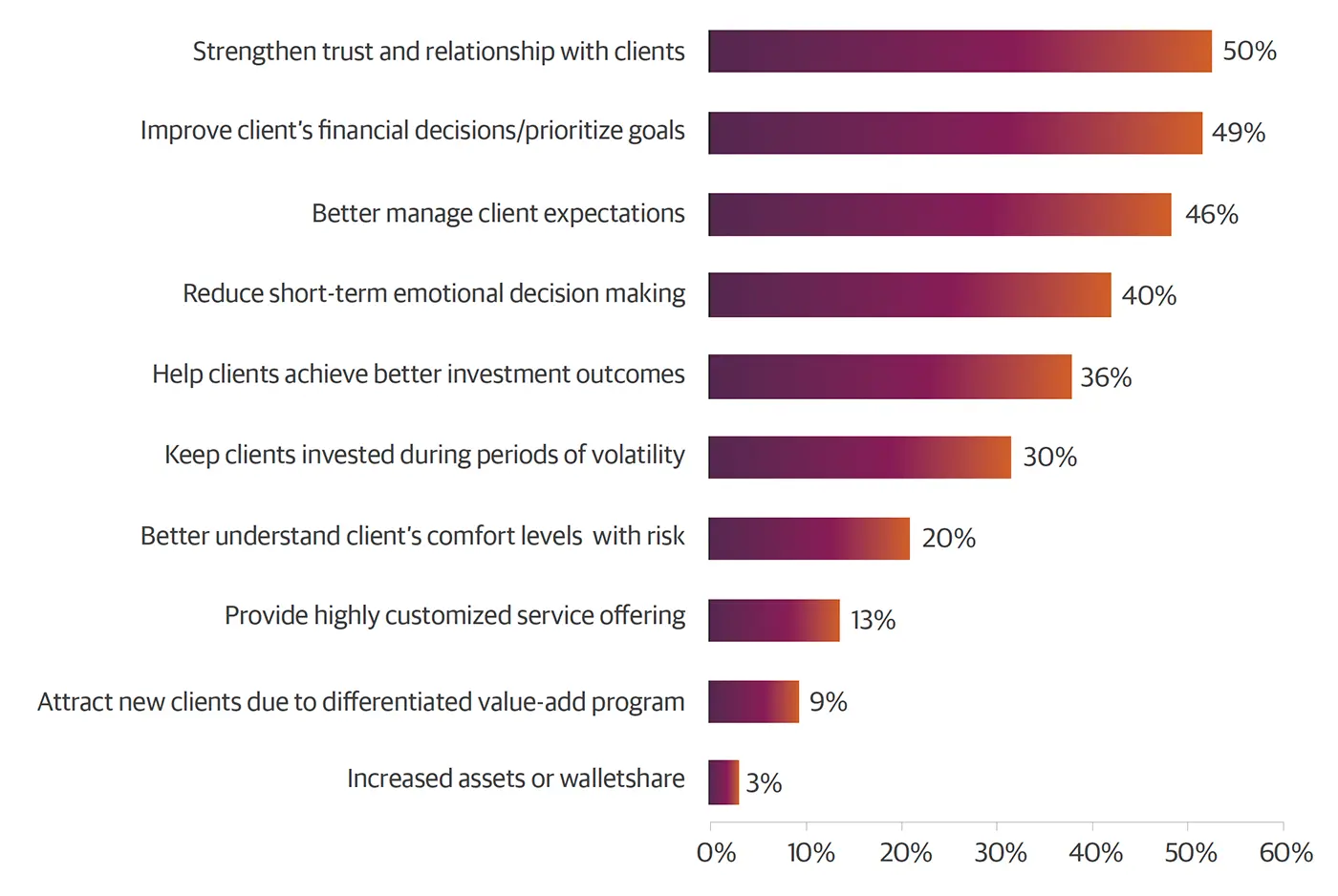
Source: Cerulli Associates, in partnership with the Investments & Wealth Institute (formerly IMCA), 2019. Analyst note: Respondents were asked, “What are the greatest benefits of incorporating behavioral finance into your practice?” Respondents could select more than one response.
Common cognitive biases among investors
- Memory bias: Recent experiences weigh more heavily in decision-making than past experiences.
- Recency bias: Concluding recent events will continue into the future.
- Confirmation bias: Emphasizing information that confirms an existing conclusion or hypothesis.
- Loss aversion bias: The fear of loss outweighs the desire to obtain gains.
- Information bias: Assessing all available information as equally important.
- Framing bias: Perceiving an event or outcome as different if presented positively or negatively.
- Anchoring bias: Relying too heavily on a past reference or one piece of information.
- Restraint bias: Overestimating one’s ability to show restraint in the face of temptation.
- Hindsight bias: Seeing positive past events as predictable and negative events as unpredictable.
- Bandwagon effect: Gaining comfort in something because many other people do (or believe) the same.
- Oversimplification tendency: Oversimplifying the probability of uncertain or complex outcomes.
- Regret avoidance: Holding onto a losing investment in the hope it will recoup losses.
- Overconfidence: Two good picks in a row can give one an illusion of skill.
Putting behavioral finance theory into practice
The challenge with bias mitigation is how to bridge the gap between behavioral finance as an academic concept and behavioral finance as a real-world investing, client communication, and practice management tool. We believe the practical application of behavioral finance principles within the Guggenheim investment process can serve as a useful model for how these ideas can be adapted to form the keystone of every advisor’s practice.
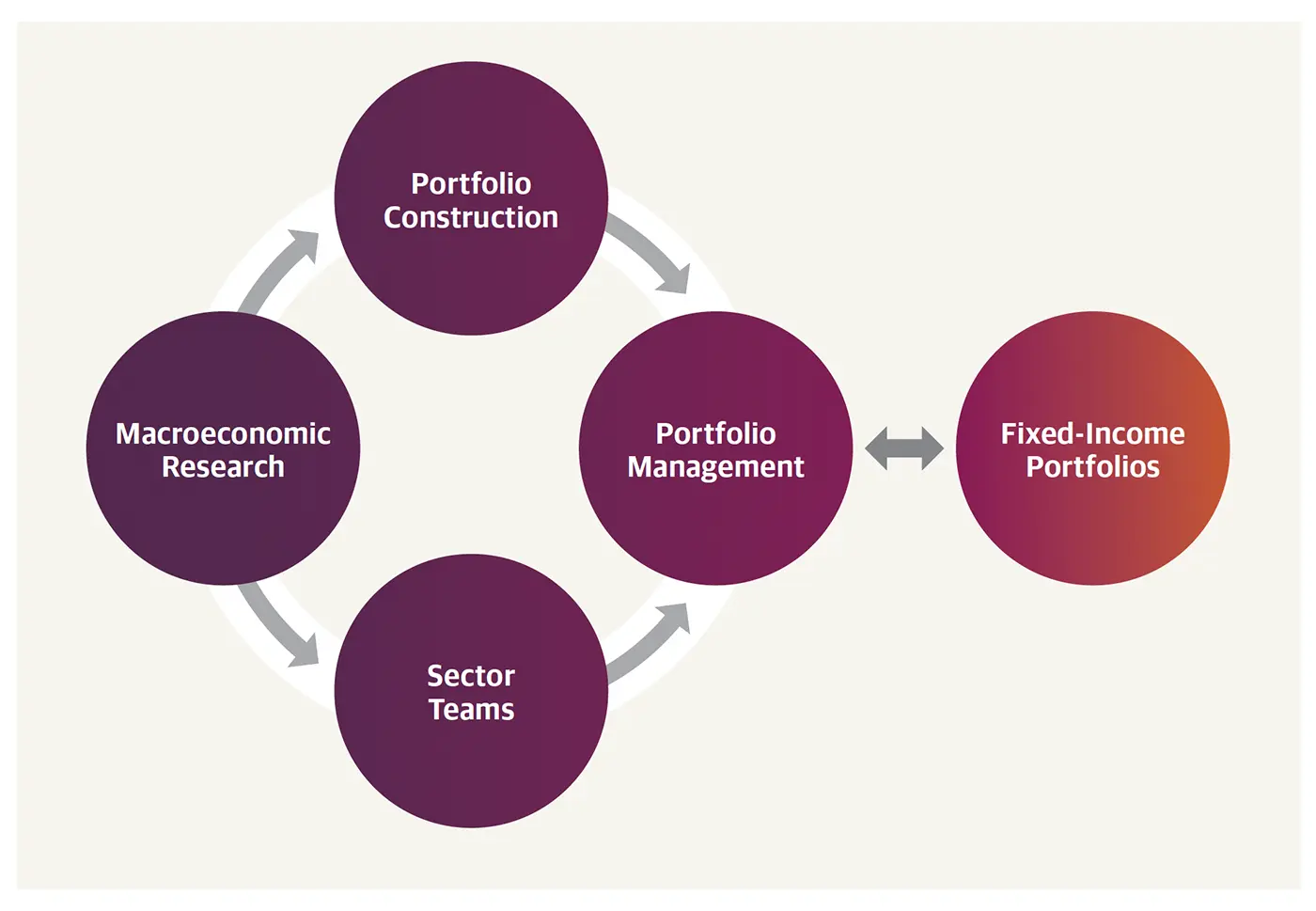
The Guggenheim investment process was founded on the principles established by Kahneman and Tversky’s advances in behavioral finance, discussed in detail in Kahneman’s seminal book “Thinking, Fast and Slow.” The investment process at Guggenheim disaggregates the primary functions of investment management—macroeconomic and investment research, sector analysis, portfolio construction, and portfolio management—into four separate groups in order to make better decisions in actively managed portfolios. The result is long-term, prudently managed portfolios built on our best ideas, the success of which is in no small part due to dispassionate, information-based decision-making brought about by the effortful integration of the activities of these specialized groups.
Not only is each team better at its specific role than if these roles were not disaggregated, but at the same time,the division of responsibility means that no one person or group can make an investment decision. At Guggenheim, investment decisions are only made in accordance with the expert input from each group. This process requires collaboration, communication, deliberation, and effort, all hallmarks of System 2 decision-making. For example, sector constraints set by the Portfolio Construction Group ensure discipline in portfolio investment and rebalancing. For security analysis, teams in the Sector Group rely on market forecasts based on macroeconomic research. Each of the four groups has more time to focus on—and is the only group responsible for—its area of expertise.
Decisions at many investment firms are left in the hands of a star investor or a small group of portfolio managers who might be more vulnerable to bias risk. We believe that a far better approach is to slow down decision-making into an orderly series of steps and, in so doing, minimize cognitive biases and remove the emotional component from the process.
 Related Article: The diversification dilemma: Tactical management and today’s evolving markets
Guggenheim’s investment process in action
At Guggenheim, the functions of investment management are divided among four independent groups. By making our investment process group-based, we slow down decision-making, ensuring that every decision is thoughtful and minimizes bias.
Macroeconomic research
The Macroeconomic and Investment Research Group provides the rest of the investment team with the outlook on the U.S. and global business cycle, market forecasts, and policy views. The group establishes the house view on the economy, the labor market, inflation, and other drivers of economic growth and investment performance. It evaluates debt and equity markets, as well as interest rates and commodities. Policy views encompass regulatory initiatives, fiscal policy, and monetary policy at the Federal Reserve and other global central banks.
Sector analysis
The Sector Group is responsible for sourcing the most compelling risk-adjusted investments, analyzing them, and providing ongoing risk monitoring. They take input from the Macroeconomic and Investment Research Group and provide security recommendations to portfolio managers, who decide on asset allocation. The Sector Group focuses on the following sectors: investment-grade and high-yield corporate bonds, bank loans, asset-backed securities, collateralized loan obligations, non-Agency residential mortgage-backed securities (MBS), commercial MBS, commercial real estate debt, municipal bonds, Agency MBS, and Treasury/Agency securities.
Portfolio construction
The Portfolio Construction Group provides strategy, research, and risk-management analysis and focuses on optimizing portfolio positioning for each client and fund by formulating model portfolios. The group also conducts portfolio-level risk analysis to evaluate whether the risk positioning is appropriate for each client. The group is not involved in the day-to-day management of a portfolio or security selection; that is the role of the Portfolio Management Group and teams within the Sector Group.
Portfolio management
The Portfolio Management Group interacts with the Portfolio Construction Group, the Macroeconomic and Investment Research Group, and the Sector Group to make appropriate allocations for any given strategy. This group synthesizes the collective work of the different groups to manage according to portfolio investment guidelines and the risk directives and needs of each client and fund. The Portfolio Management Group is also the primary point of contact for clients for any updates and reporting that may be required to fulfill our client service obligations.
Practice management: Behavioral finance helps advisors make better business decisions
By avoiding the pitfalls of allowing emotion to color investment decisions, advisors can apply similar discipline to practice management in order to work more efficiently, better categorize clients based on their behavioral characteristics, and position the practice to maximize long-term growth potential. Guggenheim’s organization benefits from the tenets of behavioral finance in the structure of our investment groups, but the same principles can be applied to individual wealth management practices.
Dr. Tali Sharot, author of “The Optimism Bias” (2011) and associate professor of cognitive neuroscience at University College London and visiting professor at MIT, explains that our cognitive biases are always with us. To mitigate or eliminate our biases, she advises that it is important to know them and plan ahead with a strategy to avoid suboptimal decisions. To organize this strategy, we have assembled a checklist of six questions to help advisors slow down their decision-making and manage their biases.
1. Are the reasons that I want to take this action emotional or rational?
Every behavioral bias has deep roots in your emotions, so it is worth taking time to determine why you are experiencing the urge to act. Anchoring bias is particularly powerful, as it tends to make you look backward when you should be synthesizing new information. In order to remove emotion from our decision-making process, we separate the functions that lead to decision-making in order to focus expertise where it is most needed (see the diagram in “Guggenheim’s investment process in action” above). Advisors who are able to separate the functions that constitute their practices should benefit from the same dispassionate approach to managing their clients’ accounts.
2. Do I have all the information I need to make this decision now?
Overconfidence and recency bias, both of which can result from something like a successful stock pick, can promote shortcuts in decision-making. While gut instinct can pay off at times, effective decision-making relies on gathering and synthesizing relevant information. Take the time to make sure you have fully thought through and analyzed an opportunity, focusing on only the most relevant information to make the best decision. Collect what you need and dismiss the rest as noise.
3. Have I carefully weighed the gains and losses that could result from this decision?
Just as overconfidence can lead to overlooking negative consequences, loss aversion bias can lead to impulse selling and inaction when an opportunity arises, potentially diminishing your clients’ returns. In fact, advisors cite loss aversion as one of the most significant factors in their failure to act. Make sure to consider the size of the unrealized loss in context—a negative move might seem painful but could be a simple rounding error when viewed in relation to the size of the portfolio. Take the time to explore the potential pros and cons of every decision in order to determine whether to act on it.
4. What is the long-term outcome if I make this decision now?
A call from an angry or panicked client can lead to oversimplification tendency, or putting out the fire by quickly buying or selling whatever the client is concerned about. But remember that you put the client’s plan together for a reason, and every decision you make should serve the long-term goals of that plan. This approach can sometimes be painful in the short term: Before the sell-off in March 2020, our concern for several quarters was that spreads were too tight, and we positioned defensively as a result. This meant we underperformed in the near term, but when markets plunged in March, our clients’ portfolios withstood many of the negative effects, and we were in a position to take advantage of opportunities in its wake.
5. Is this decision consistent with the factors that led to my client’s financial plan or my business plan?
With memory bias, recent events can weigh more heavily on your decision-making than more distant experiences. As we discuss in “Putting pullbacks in perspective,” downward moves and corrections are signs of a normal and healthy market. Investors who stuck to their plans even during significant pullbacks recovered faster than investors who sold into temporary corrections. The same logic applies to practice management: Only make decisions that support the growth and development of your business plan.
6. Is this decision something I want to repeat going forward?
Every decision you make should serve the long-term vision for your clients’ portfolios and for your business. Hindsight bias may have you looking at past successes as if they were inevitable, but they weren’t: You made smart decisions when the future was uncertain. It is important to examine the mechanics of those decisions to determine what led to a positive outcome. This information is vital in honing a process that produces effective decision-making.
A case in point: Planning client communications to avoid cognitive bias
Nothing rattles investors’ confidence—and, by extension, that of their financial advisors—like unexpected market volatility. As a way of framing dispassionate investment decisions as a more prudent way to plan for the future, behavioral finance can help build trust and strengthen client relationships through consistent and holistic financial plans.
For example, a market correction can generate a lot of anxiety, but pullbacks are a natural and inevitable function of a healthy market. That is why advisors should create a financial plan with their clients that addresses pullbacks and is informed by historical perspective, not emotion. Looking at post-World War II market pullbacks, the majority of declines fall within the 5%–10% range, with an average recovery time of approximately one month, while declines of 10%–20% have an average recovery period of approximately four months. While pullbacks can be emotionally unnerving, they generally do not undermine a well-diversified portfolio.
A patient investment system based on behavioral finance tenets can help clients avoid potential losses incurred by selling into a sell-off. If advisors take the time to talk to clients and demystify pullbacks, it reduces clients’ anxiety the next time one inevitably occurs. If clients are prepared in advance, advisors can avoid panicked client calls.
An important aspect of this discussion about pullbacks is the cognitive bias of loss aversion. As Kahneman and Tversky said, “Losses loom larger than gains.” This means that investors will treat a prospective loss differently than they would an equivalent gain. This aversion to loss demonstrates that clients are more willing to book a small loss at the expense of a longer-term objective. Advisors and their clients need to be on guard for this bias and keep the fluctuations in proper perspective. When confronting a decline in value, clients need to be reminded about the size of a loss relative to their current wealth rather than the loss itself. This process will temper the System 1–driven urge to sell and stave off frequent trades that crystallize losses. “All of us,” says Kahneman, “would be better investors if we just made fewer decisions.”
That may sound great on paper, but how do advisors put theory into practice? There is a lot of research on historical market behavior that can support dispassionate analysis and discussion of current market events. Guggenheim’s long-running Crucial Conversations—Putting Pullbacks in Perspective series discusses how to differentiate between pullbacks. We also produce a series of forecasts that clearly show how select macroeconomic markers can provide insights into the future direction of the business cycle.
Guggenheim Investments’ Thought Leadership Group also publishes a range of sector-specific reports that set out timely macroeconomic and investment themes, explain how those themes inform our portfolio allocation, and identify which sectors we see the biggest opportunities in going forward.
Conclusion
As long-term investors, we have found the advances in behavioral science made by Kahneman and Tversky to be extremely valuable in the way we approach our business. In fact, their work formed the foundation of our investment process from the start: Understanding the pitfalls of System 1 decisions, which are not generally strategic and can easily derail long-term portfolio planning, led us to develop a process that is specifically designed to mitigate or eliminate their inherent cognitive biases. As our business has evolved and grown, the goal of System 2 decision-making has become ingrained in everything we do.
We believe the tenets of behavioral finance that have helped us can translate readily into building a process that will help advisors with their practice management. Slowing down the process by asking these six questions (or versions of them) is a strategy designed to mitigate cognitive biases and make better decisions. Whether an advisor is looking to make smarter investment decisions, effectively manage client expectations, or build a better wealth management practice, taking these steps should help establish a process that is predictable, repeatable, and scalable.
The opinions expressed in this article are those of the author and the sources cited and do not necessarily represent the views of Proactive Advisor Magazine.
Investing involves risk, including the possible loss of principal.
This material is distributed or presented for informational or educational purposes only and should not be considered a recommendation of any particular security, strategy, or investment product, or as investing advice of any kind. This material is not provided in a fiduciary capacity, may not be relied upon for or in connection with the making of investment decisions, and does not constitute a solicitation of an offer to buy or sell securities. The content contained herein is not intended to be and should not be construed as legal or tax advice and/or a legal opinion. Always consult a financial, tax, and/or legal professional regarding your specific situation.
This material contains opinions of the author, but not necessarily those of Guggenheim Partners LLC or its subsidiaries. The opinions contained herein are subject to change without notice. Forward-looking statements, estimates, and certain information contained herein are based upon proprietary and non-proprietary research and other sources. Information contained herein has been obtained from sources believed to be reliable but are not assured as to accuracy. Past performance is not indicative of future results. There is neither representation nor warranty as to the current accuracy of, nor liability for, decisions based on such information. No part of this material may be reproduced or referred to in any form without express written permission of Guggenheim Partners LLC.
©2022 Guggenheim Partners LLC. Guggenheim Investments represents the investment management business of Guggenheim Partners LLC. Securities offered through Guggenheim Funds Distributors LLC. For financial professional use only. Do not distribute to the public.
Reprinted with permission from Guggenheim Investments.
Guggenheim Investments is the global asset management and investment advisory division of Guggenheim Partners and manages assets across fixed-income, equity, and alternative strategies. Guggenheim Investments focuses on the return and risk needs of insurance companies, corporate and public pension funds, sovereign wealth funds, endowments and foundations, consultants, wealth managers, and high-net-worth investors. They offer frequent market commentary and white papers for their clients and the investment community. www.guggenheiminvestments.com
RECENT POSTS

Intergenerational attrition, not AI, might be advisors’ most relentless threat

Fosback’s Absolute Breadth Ratio shows a quiet market

How advisors can help close the financial literacy gap
The changing dynamics of AI infrastructure and AI hyperscalers