Statista reported last week on the Federal Reserve’s final rate cut of 2025, one of the bigger financial stories heading into year-end:
TABLE 1: LATEST RATE-CUTTING CYCLE FOR THE FEDERAL RESERVE
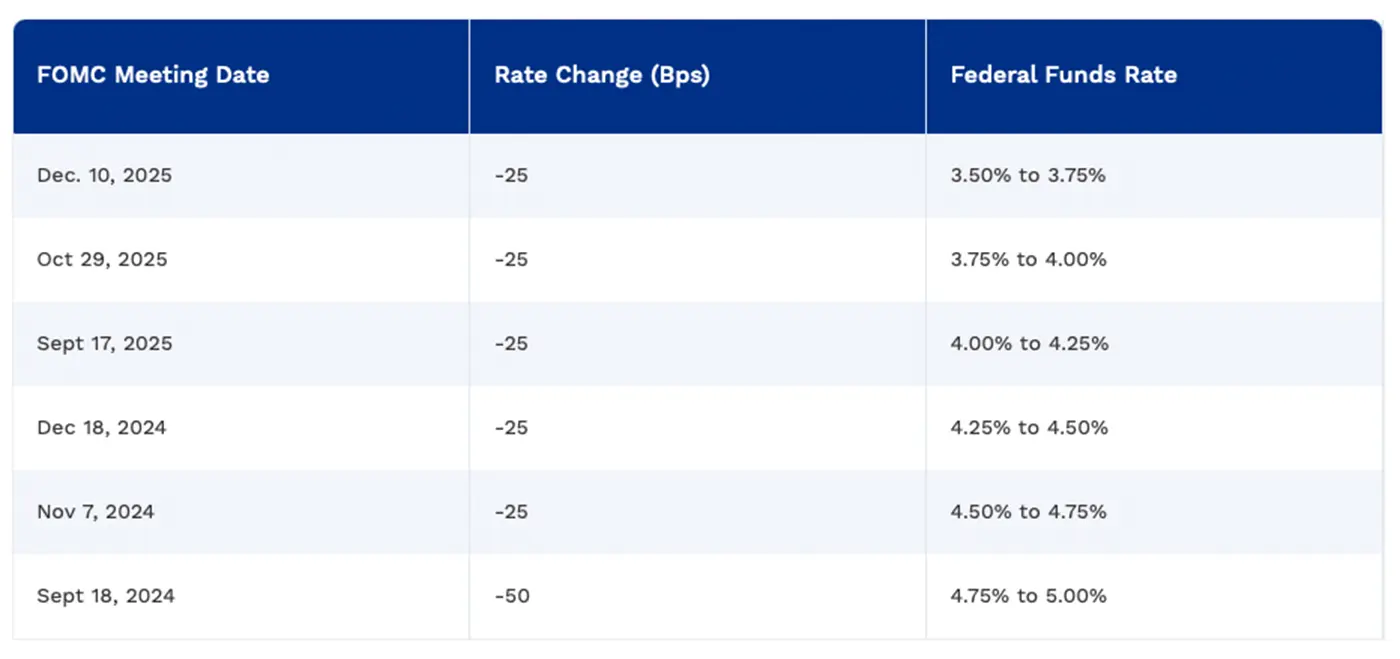
Source: Forbes
 Related Article: Is there a ‘right’ federal funds rate?
What is the path forward for the fed funds rate?
Yardeni Research offered several observations following the Fed’s announcement, focusing on both policy messaging and the range of views among Fed officials:
“In his prepared remarks at today’s press conference, Fed Chair Jerome Powell rightly observed the obvious: ‘The adjustments to our policy stance since September bring it within a range of plausible estimates of neutral and leave us well positioned to determine the extent and timing of additional adjustments to our policy rate based on the incoming data, the evolving outlook, and the balance of risks.’
“On average, Fed officials believe that the neutral federal funds rate is 3.00%. Two more 25bps rate cuts in 2026 would bring it to neutral. However, monetary policy should remain relatively restrictive until inflation falls to the Fed’s 2.0% target. Powell seems to believe that will happen in 2026. Powell repeated his new ‘well positioned’ mantra a few times, suggesting that the Fed might pause rate cutting for a while. …
“There were three dissenters at the latest FOMC meeting: two opposed to today’s rate cut and one calling for a 50bps cut. According to today’s dot plot, three of the 19 FOMC participants estimate that the FFR is now below their neutral-rate estimates. Seven of them expect no more rate cuts in 2026.
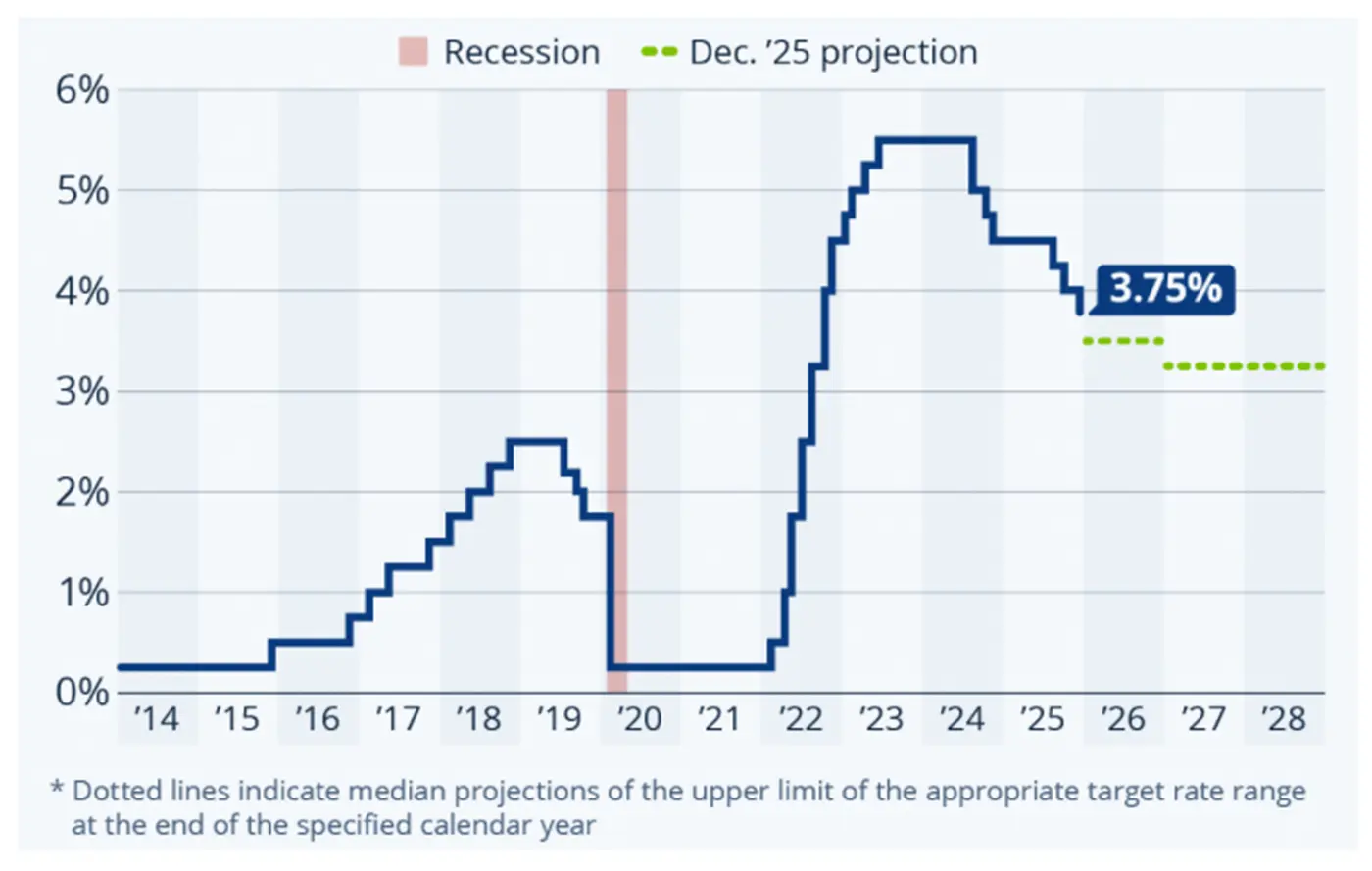
“The Summary of Economic Projections (SEP) shows that the median estimate of the 19 participants is that the FFR will fall to 3.40% next year and 3.10% in 2027.”
Statista also highlighted the divisions reflected in the Fed’s latest projections:
FIGURE 1: FED SIGNALS RATE-CUT CAUTION MOVING FORWARD
Upper limit of U.S. federal funds target rate range*
Sources: Statista, Federal Reserve
Lack of consensus—and more uncertainty
Reactions to the Fed’s December rate cut reflected the growing divide over the appropriate path for monetary policy. President Trump criticized the move as insufficient, arguing the cut should have been twice as large. At the same time, some current, incoming, and non-voting Fed officials preferred a pause, citing inflation concerns, the need for further data, and labor market weakness.
The decision included three dissents among voting members. Fed Governor Stephen Miran voted for a larger 0.5% cut, and Kansas City Fed President Jeffrey Schmid and Chicago Fed President Austan Goolsbee voted to hold rates steady.
Noted economist Mohamed El-Erian, who has often differed with the Fed’s recent policy approach, said in a Fox interview that the 25 basis point cut was “the right thing,” but he wishes the Fed had started cuts earlier and should indicate that it will go further. “They should have started cutting in July,” he said, adding, “My biggest concern about this Fed is the lack of a vision. … They cause much more uncertainty than they should.”
First Trust also weighed in, pointing to both near-term data risks to the Fed’s outlook and longer-term leadership changes:
Analysis from CNN posed an interesting question: Has a major pillar of the market’s 2025 comeback rally now been removed?
“Wall Street got the rate cut it wanted. But with the Federal Reserve set to take a more cautious approach to trimming interest rates in 2026, investors are now left to wrestle with other concerns that had been put on the back burner while Fed rate cuts were top of mind.
“The Fed’s three consecutive cuts in September, October and December helped markets climb higher and look past nerves about artificial intelligence and uncertainty about tariffs.
“With Fed Chair Jerome Powell telegraphing that rate cuts might be on pause for a while, Wall Street’s focus is turning elsewhere. And uncertainty that had been bubbling under the surface becomes harder to ignore when there isn’t Fed rate-cut optimism to help boost stocks.”
RECENT POSTS