
Engineering comprehensive planning solutions for clients
Engineering comprehensive planning solutions for clients

Lincoln Financial Securities Corporation
Read full biography below
When you are managing engineering systems, you need to thoroughly understand the risks, the huge number of variables affecting outcomes, and the need to develop contingency scenarios. I think the connection to building clients’ financial plans is obvious. I have always been very analytical and data-driven; if the numbers and analysis of probabilities do not support a specific course of action, it is likely not a good one and other options need to be examined.
 I was completing my service in the U.S. Navy Reserve while working at Newport News Shipbuilding and was thinking about what I wanted to do for the rest of my life. I decided that financial services was an attractive option. My father had been an enthusiastic member of an investment club while I was growing up, and I have always been interested in the financial markets. I decided to pursue an MBA degree part-time while I was working. I loved the quantitative aspects of financial analysis in my courses, though the marketing side was also very interesting.
In 2004 I made the move to financial services and was recruited by a large national firm. That experience taught me that I want to take a holistic view of the role of being a financial advisor, not a transactional one. Around the time that I was switching careers, my father passed away. There were some significant tax issues with his estate that could have been easily avoided. This was a valuable lesson about the importance of staying on top of clients’ changing family circumstances and deeply understanding all aspects of a client’s financial situation.
I am very pleased with my career decision and with affiliating with Lincoln Financial. I have a great deal of freedom in running my practice while receiving a strong level of support and resources from Lincoln. I can work with several different types of third-party money managers, selecting the managers’ strategies that make the most sense for a client’s specific financial situation.
The market’s brutal behavior at that time was quite an experience. Clients with a decent allocation to guaranteed annuities were pleased with their positions. Other clients who were allocated more heavily to equity mutual funds suffered some significant losses along with the market. I was able to convince most clients to stay the course, uncomfortable as that was. I will never forget one of my clients who insisted on selling everything essentially at the bottom of the market, against my recommendation. I never want to see a client feeling forced into that position or mind-set again.
I believe I need to build out portfolio solutions that can serve clients well in any kind of market environment. That can include a significant portion of actively managed strategies that are focused on risk management and that can be flexible and tactical, depending on market conditions. Unlike your typical mutual fund, the strategies I use in managed accounts do not have to always be in a predominantly long-only position. They can move to varying levels of cash or even go inverse the market in some cases.
This flexibility and emphasis on risk management not only makes sense from an investment standpoint, it also helps me in managing client expectations and their emotions. Many of these strategies are purely quantitative and based on algorithms. That is very appealing given my quantitative orientation. They are designed to smooth out volatility and can have the ability to sidestep unfavorable market conditions. Are they perfect in every market situation? Of course not. That’s why I want well-diversified client portfolios. I believe managed strategies can help offer a higher probability of more consistent returns over the long run. That’s exactly what I look for as a part of the money management for my clients.

My initial conversations with clients around retirement are informal and are designed to get at their goals for the future. What is truly important to them in retirement? What is their ideal date to retire? Where would they like to live, and what do they see themselves doing? What is their family situation in terms of children, parents, grandchildren, etc.?

 First, I want to communicate a sense of transparency and trustworthiness. I am upfront about how I work, the way I am compensated, and my emphasis on working as a team together. In return, I want my clients to feel that they can always be fully transparent with me and that I will treat the relationship in a highly confidential manner.
Second, I emphasize to clients that even though retirement-planning issues can be very complex, I am there to educate them and guide them through the process in a way they are comfortable with. I use an analogy from the military that we are sitting together in the command and control center. We have many sophisticated tools that can be used, and it is my role to bring to bear a high degree of expertise to help them determine the tools that will help them reach their financial and lifestyle goals in retirement.
Lastly, even if our main objective is developing a retirement income plan, I want clients to know I can help them develop a holistic financial plan that can cover many key areas, such as legacy planning, college-funding planning, or how they are preparing to fund health care needs in the future. I am there for them as their financial advisor and coach and am prepared to offer support for all their financial needs. I believe this approach leads to highly integrated and efficient plans, as well as enduring client relationships.
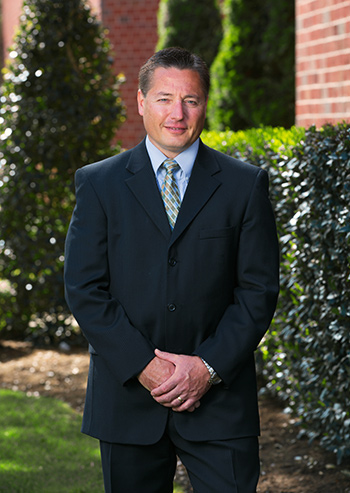
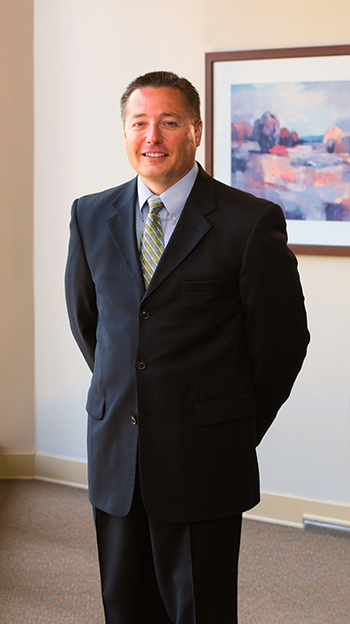
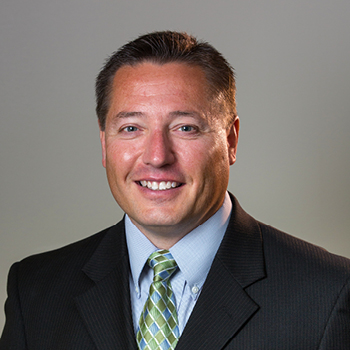 Michael Murphy is a financial advisor and a registered representative with Lincoln Financial Securities Corporation, located in Chesapeake, Virginia. He provides financial guidance for a variety of clients, offering integrated solutions for individuals, business owners, professionals, executives, and retirees. He works closely with clients to develop estate, business succession, retirement, and financial plans.
A native of Harrisburg, Pennsylvania, Mr. Murphy attended public schools in the area, where his father was a school administrator. A skilled athlete, Mr. Murphy was recruited to attend college and play football at the United States Merchant Marine Academy in Kings Point, New York. He graduated with a degree in marine engineering systems and completed eight years of service as an ensign in the U.S. Navy Reserve. Following graduation, Mr. Murphy worked as an engineer at Newport News Shipbuilding, where he worked with cranes and lifting/handling equipment used to support nuclear engineering operations.
Mr. Murphy earned a master’s degree from Virginia Polytechnic Institute and State University in systems engineering and an MBA from the College of William and Mary. He has also earned the professional credentials of Chartered Financial Consultant (ChFC) and Retirement Income Certified Professional (RICP). Mr. Murphy began his career in financial services in 2004, working for a national firm. After several years in the industry, he joined Lincoln Financial Securities Corporation in 2014.
Mr. Murphy and his wife live in the Chesapeake area and have a son and daughter, both in college. He is deeply involved with the Optimist International Club in his area, which is involved in a variety of children’s programs and charitable efforts. Mr. Murphy also supports the Windsor Castle Park Foundation in Smithfield, Virginia. He enjoys “a variety of interests, including running, astronomy, and art.”
Disclosure: Securities and advisory services offered by and through Lincoln Financial Securities Corporation, a registered broker-dealer. Member SIPC. Lincoln Financial Securities and their representatives may not offer legal or tax advice. Please see your personal professional regarding your individual circumstances. 4016 Raintree Road, Suite 220, Chesapeake, VA 23321. LFS-1788568-050417.
As of 2021, Mr. Murphy is registered with Cambridge Investment Research Inc.
Photography by Don Monteaux