
Why active strategies complement holistic portfolio management
Why active strategies complement holistic portfolio management

Active strategies, combined with more traditional passive strategies, can offer the potential for lower drawdowns and volatility, multiple layers of diversification and risk management, and enhanced returns.
As financial and investment information became more abundant and accessible, paying a fee to a professional was less of an advantage. Managers began to find it more difficult to convert value into outperformance, or alpha, compared to major benchmarks. As a result, stock-picking managers would buy top conviction names and give them a little more weight. To minimize the risk of trailing their benchmark, they would then add in many smaller positions that would all too often erode the value added by the high-conviction names. The result was that investors paid more for an investment experience that closely aligned to that of an index.
Passive management firms—and then investors—started to catch on to this and took action. Investment dollars began flowing from the powerhouses of active management to passive firms such as Vanguard. The sales pitch was simple and resonated with many investors: Why pay someone to replicate an index when you can buy a strategy that does so for a much lower cost?

It follows, then, that active investment management that offers value beyond a basic index fund will cost more. Using active management can involve setting personal financial benchmarks and expectations for investors and tracking progress based on those individual parameters—which can be helpful for investors who aren’t comfortable with the level of risk associated with certain index funds. Actively managed strategies can be designed to aim for lower drawdowns and volatility, employ multiple layers of diversification and risk management, or seek enhanced returns. Regardless of what the goal of the active management approach is, it should provide value to the total portfolio.
When advisors develop financial plans with clients, they typically share their approach. For successful advisors, this approach is usually holistic in nature and “leaves no stone unturned.” Advisors analyze elements such as the impact of life insurance, annuities, trusts, and charitable giving while considering factors like time to retirement, life expectancy, and legacy goals to form a complete picture of a client’s financial world. After examining these components, advisors will recommend an optimal asset allocation for a client to progress toward their financial and life goals. It makes sense that a holistic approach to financial planning should be accompanied by a similarly holistic approach to investment management.

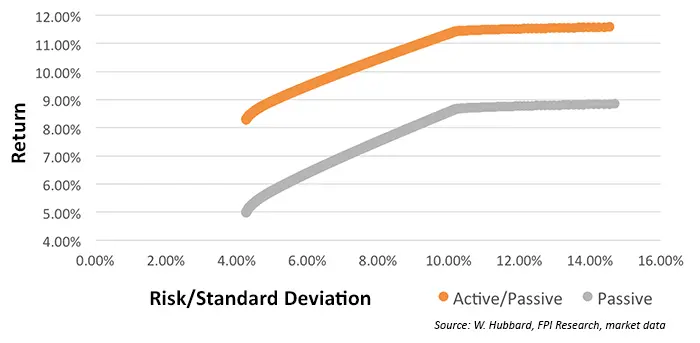
The following graphs highlight some of the differences between active/passive combinations of strategies and purely passive approaches. Passive assets are represented by ETFs tracking the S&P 500, a bond index, and gold, going back to 2005. Several active strategies were included in the analysis, including a momentum and mean-reverting strategy with different trading intervals. No rebalancing is assumed in this analysis.
The first thing everyone learns when diversifying assets is to buy things that are different, like stocks and bonds. When stocks go up, bonds go down, and vice versa. Over time, this smoothing effect produces better returns for less risk. Adding active strategies to a passive portfolio has the same effect as adding bonds to a portfolio of all stocks. The efficient frontier moves out and performance possibilities improve.
Time consideration involves making sure all of the active strategies in a portfolio do not have the same trading frequency and that the active strategies trade on different interval lengths. An example might be having a strategy with a potential to trade daily or monthly and combining it with one that might have a handful of trades in a given year. Sometimes technology stocks are in vogue, and sometimes it’s hot to own consumer discretionary stocks, but it’s better to always own a little of both to avoid trying to chase what “the market” is doing at a single point in time. Sometimes it pays to trade every day or every few days, while sometimes it pays to hold on and ride the trend in the market.
Riding the trend makes style diversification important as well. Style refers to the trading style of a strategy. Most active strategies fall into two categories: momentum and mean reverting. Momentum strategic management refers to strategies that identify trends in the market and invest accordingly. They typically miss the tops and bottoms by buying and selling based on underlying shifts in the market. Mean-reverting strategies take the opposite approach by attempting to identify market extremes and looking for a move back toward equilibrium. The two styles are the opposites of each other but offer complementary attributes. When “the trend is your friend,” all momentum strategies will tend to outperform mean-reverting strategies, which have more of a tendency to get “chopped up” trying to pick tops and bottoms along the way.
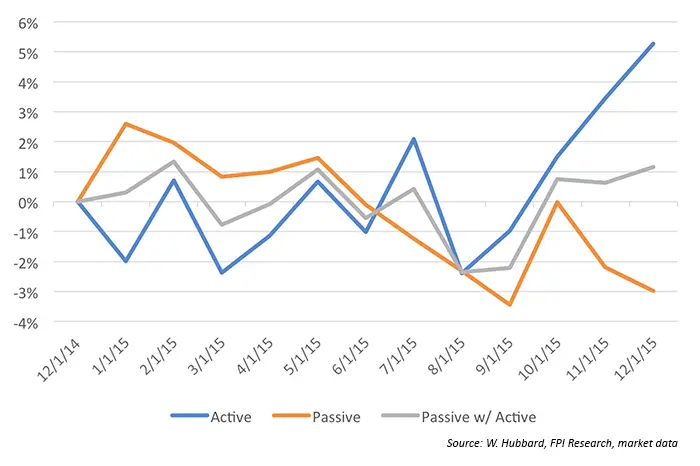
Improving efficient portfolios is possible with time, style, and manager diversification, but what happens when the market is directionless and difficult to trade, like it was in 2015? In 2015, the S&P 500 lost value in terms of absolute price but made money due to dividends, while gold declined nearly 10%. The following illustration highlights what happens when you properly incorporate several active strategies into a traditional passive portfolio built of stocks, bonds, and gold.
In 2015, one of the active strategies included in this analysis, a momentum strategy, declined more than 20%. A mean-reverting active strategy included in the analysis increased over 20%. Other active strategies’ returns fell between the two extremes. A purely passive strategy declined approximately 3%.
When meeting with third-party investment managers, ask open-ended questions around the methodology behind active strategies, the time frames the strategies will trade, and how strategies differ in management style and rules orientation. These types of questions will result in increased confidence in selecting a holistic portfolio of active—and passive—strategies that are well-diversified on many levels.
 William Hubbard, CFA, is a quantitative money-management analyst. He has spent his career focusing on how active management can generate results regardless of market direction. He earned his bachelor’s degree in electrical engineering, with a minor in economics, from Oakland University.