

With the next FOMC meeting—March 15–16—coming under increased scrutiny, a great deal of analyst community attention is equally focused on interest rates and monetary policy around the globe. (Not to mention the state of U.S. economic growth, the outlook for domestic inflation, and the state of the energy industry and oil prices.)
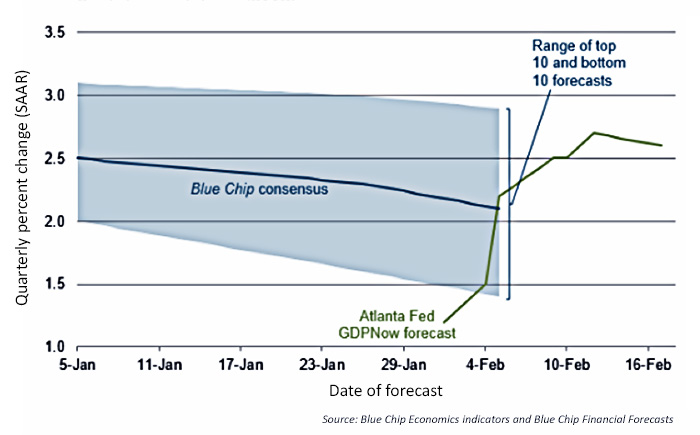
EXHIBIT 1: ATLANTA FED Q1 2016 GDP FORECAST
Specifically, while the Fed considers whether to continue on its previously telegraphed path of four rate hikes in 2016, the rest of the globe is increasingly operating under a negative-interest-rate scenario. It is a complicated situation, indeed, with several major conflicting factors at work:
- A Fed that many say has some “face-saving” lurking in the back of any decision, and one that will perhaps be hawkishly emboldened by recent “hotter” inflation data, a better trend on high-frequency economic data and sentiment measures, and the recent uptick in equity markets. In fact, the Atlanta Fed’s GDPNow forecast for Q1 2016 GDP growth has rocketed higher over the past several weeks, now standing at 2.6%.
- The U.S. continues to appear to be “the best house on a lousy block,” at least as far as economic growth estimates and stock-market performance are concerned. U.S. equity indexes significantly trimmed YTD losses last week and declines for the S&P 500 and DJIA were about 6% for the year. Global equities also rallied, but several key European and Asian markets still are suffering YTD losses in the mid to high double digits.
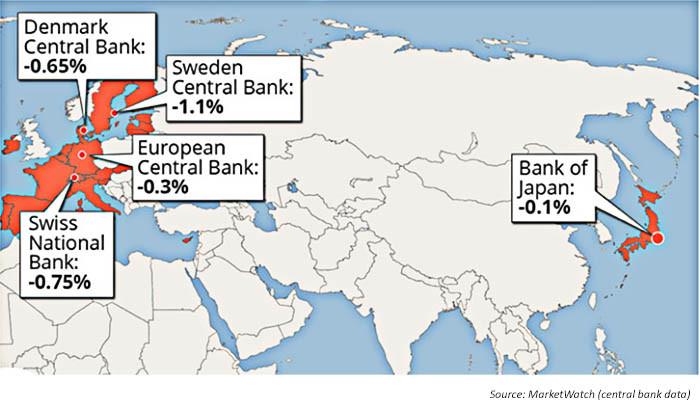
- The “R” word (recession) continues to be bandied about for the global economy, although a bit less frequently for the U.S. An alarming precursor of this, according to Yale University’s Stephen Roach (formerly of Morgan Stanley), is the fact that many major economies (most notably Europe and Japan) are now operating under a negative-interest-rate scenario. Said Roach last week in a much-publicized article, “Central Banking Goes Negative”:
In what could well be a final act of desperation, central banks are abdicating effective control of the economies they have been entrusted to manage. First came zero interest rates, then quantitative easing, and now negative interest rates — one futile attempt begetting another. Just as the first two gambits failed to gain meaningful economic traction in chronically weak recoveries, the shift to negative rates will only compound the risks of financial instability and set the stage for the next crisis.
EXHIBIT 2: CENTRAL BANKS WITH NEGATIVE INTEREST RATES
Fund manager David Moenning, of Heritage Capital Research, summed it up recently from a market perspective: “Lest we forget, it was global central bank intervention that eventually rescued the market in both cases (2010 and 2011). And to be sure, there is more QE coming from the ECB and BOJ. But with the U.S. Fed currently pursuing a divergent monetary path (which is supported by the recent inflation data), I’m not sure investors should count on the same outcome this time around.”